

Table of Contents
- Signs of High Quality Furniture Construction
- How to Inspect Vintage Sofa Frames Before You Buy
- Evaluating Fillings, Cushions, and Upholstery Fabric
- The Cost of Reupholstering a Vintage Sofa: When to Restore and When to Walk Away
- Chemical and Allergen Safety in Second-Hand Upholstered Furniture
- Your Field Kit: Tools and a Step-by-Step Inspection Checklist
- Conclusion
- Frequently Asked Questions
Last Updated: September 28, 2026
Signs of High Quality Furniture Construction
Learning how to check for quality in vintage upholstered furniture starts with the frame, because the frame decides everything else. A solid wood frame with tight joinery can last another fifty years. A stapled plywood frame will wobble within a season. This guide walks you through the exact checks to use when evaluating pieces for a showroom.
Here’s the good news: you don’t need to be a woodworker to spot the difference.
High-quality vintage furniture shows three things at once:
- A solid wood frame made from hardwood like oak, maple, or walnut
- Joinery that locks wood together instead of relying on glue or staples
- Cushions that bounce back when you press them
Most buyers check the fabric first. That’s backwards. Fabric is replaceable. A cracked frame is not.
Dovetail Joints, Mortise and Tenon, and Other Joinery Clues
Dovetail joints and mortise and tenon joints are the clearest signs of high quality furniture construction. Both interlock wood pieces mechanically, so they hold tight for decades without glue.
Here’s what to look for:
- Dovetails: interlocking wedge shapes, usually in drawer corners
- Mortise and tenon: a rectangular peg fitted into a matching hole, common on chair and sofa legs
- Corner blocks: triangular wood blocks screwed into frame corners for bracing
- Dowels: round wooden pins visible at joint seams
Run your fingers along the underside of the frame.
Bring a small flashlight. Most joint problems hide underneath the frame where showroom lighting never reaches.
How to Inspect Vintage Sofa Frames Before You Buy
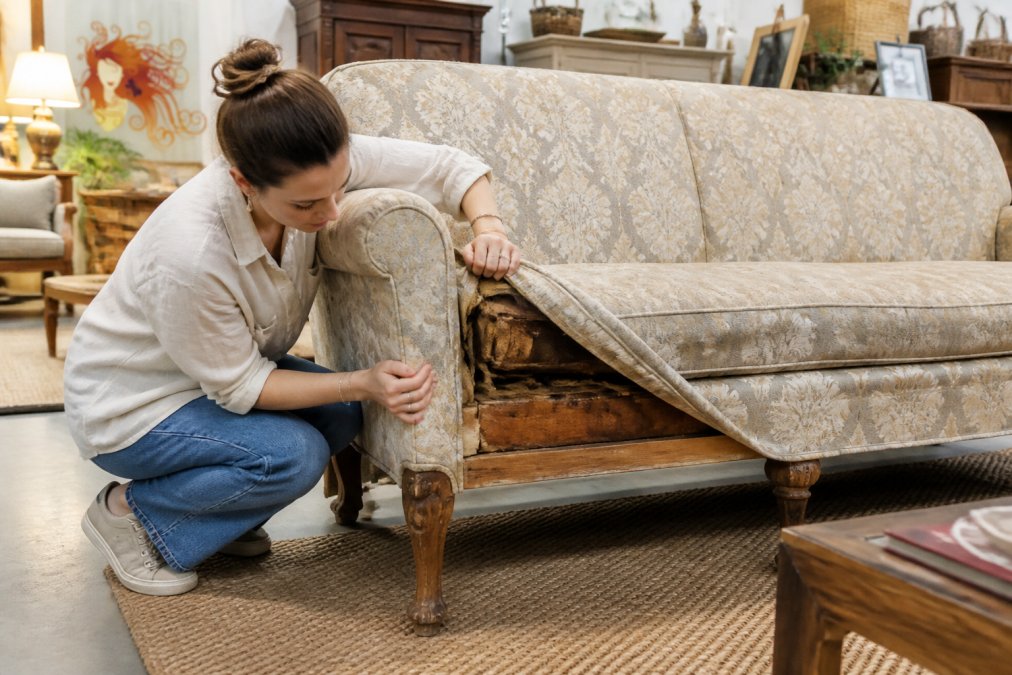
To inspect vintage sofa frames, work from the outside in: test stability first, then get underneath and read the joinery. Frame stability is the single best predictor of whether a piece is worth restoring, because every other repair, cushions, springs, fabric, is cosmetic next to a broken rail.
Checking Frame Stability and Spotting Structural Damage
A stable frame stays silent and level under pressure. Test it in this order:
- Press down hard on one arm, then the other, and feel for give at the joint where the arm meets the seat rail
- Lift one front leg a few inches and set it down, a frame in good shape settles without a twist
- Rock the piece gently side to side and listen for creaks, pops, or grinding
- Sit on one end of the seat and then the other, checking whether the opposite corner lifts off the floor
-
Seat rails, the horizontal boards running front to back under the seat
-
Corner blocks, triangular wood braces screwed or glued into the inside corners
-
Leg blocks, the reinforced blocks where legs attach to the frame
-
Stretchers, the crossbars connecting legs on some styles
-
Dark water stains or soft, spongy wood that dents under a fingernail
-
Fresh screws driven at odd angles, a sign of a past repair that may not hold
-
A rail that flexes independently of the frame around it
-
Corner blocks that have popped loose or are missing entirely
-
A frame that sits unevenly on a flat floor
A magnet is your fastest joint test. Run it along the underside of a rail, if it snaps to a hidden screw or staple, that joint has been repaired or reinforced. Original mortise-and-tenon and dovetail joints hold without metal fasteners.
Reading the Joinery Under the Upholstery
You often can’t see the joint itself, so read the evidence around it. Loose dovetail joints and mortise and tenon joints announce themselves as a hairline gap at the seam, a slight step where two boards meet, or a faint creak when you load the frame. A joint that has been re-glued usually shows squeeze-out, hardened beads of glue along the seam, or a screw driven through the face of the rail.
Evaluating Fillings, Cushions, and Upholstery Fabric
Cushion and fabric condition tells you how much work a piece needs. Horsehair filling and down-filled cushions are the gold standard in antique and vintage pieces. Both last decades when cared for.
- Springs back fast: foam is healthy
- Stays compressed: foam is failing
- Crumbles at the edges: replace it
A musty smell usually means moisture reached the padding, not just the fabric. Reupholstering won’t fix it if the frame is still damp inside.
The Cost of Reupholstering a Vintage Sofa: When to Restore and When to Walk Away
The cost of reupholstering a vintage sofa depends on three variables: fabric, labor, and how much of the frame needs repair. Most guides stop there and tell you to ‘get a quote.’ That’s not a decision framework, it’s a shrug. Here’s how to actually run the numbers before you commit.
The Three Cost Buckets
1. Fabric. This is usually the largest single line item and the one you control most. Upholstery fabric is sold by the yard, and a full-size sofa typically needs somewhere in the range of 12 to 20 yards depending on the style, whether the piece has a skirt, and whether the pattern requires matching. Fabric runs the gamut from budget-friendly woven blends to premium wools and performance weaves, and the spread between the cheapest and most expensive options is wide.
The Restoration Math
Before you commit, run this simple comparison:
- Finished value, what a comparable piece in restored condition actually sells for in your market
- Acquisition cost, what you paid or are about to pay for the piece
- Restoration cost, fabric + labor + any frame or spring work
If acquisition plus restoration lands comfortably below finished value, restore. If it lands at or above finished value, you’re paying for the experience of owning the piece, not building equity, which is fine, as long as you know that’s the trade.
The Decision Table
| Situation | Recommendation | Why |
|---|---|---|
| Solid frame, worn fabric | Reupholster | Best value; frame lasts decades |
| Good frame, bad foam | Replace cushions | Low cost, high payoff |
| Cracked frame, good fabric | Walk away | Frame repair rarely holds |
| Water damage or odor | Walk away | Hidden rot and allergens |
| Loose joint, otherwise sound | Negotiate and repair | Small fix, big discount |
Restoration makes sense when the frame is sound and the durability of the piece justifies the spend. It rarely makes sense when you’re paying to rebuild the bones. Get a written quote that itemizes fabric, labor, and any frame work separately, a single lump-sum number hides where the money is going and makes it impossible to compare shops.
Ask two questions before you buy: Is the frame sound? And does acquisition plus restoration stay under finished value? If the answer to either is no, walk.
Chemical and Allergen Safety in Second-Hand Upholstered Furniture
Second-hand upholstered furniture can carry dust mites, pet dander, mold spores, and lingering odors from smoke or pets. These are the hidden costs most buying guides skip.
Before you buy, ask:
- Has the piece been cleaned or professionally treated?
- Did it come from a smoke-free, pet-free home?
- Does it smell neutral after sitting in fresh air?
A simple plan:
- Vacuum both sides of every cushion
- Steam-clean fabric before bringing it inside
- Air the piece out for a day or two
- Replace old foam if odors persist
Your Field Kit: Tools and a Step-by-Step Inspection Checklist
- Flashlight for the underside
- Tape measure for dimensions
- Gloves for dusty frames
- A small magnet to test for steel springs
- A notepad for photos and notes
Then run this checklist:
- Press each corner for flex or noise
- Lift one leg and check for level
- Look underneath for cracks, stains, or old repairs
- Check drawer corners for dovetail joints
- Squeeze cushions and watch recovery speed
- Sit down hard once to test spring tension
- Inspect seams, armrests, and tacking lines
- Smell the piece after it airs out
A sound frame plus healthy springs beats perfect fabric every time. Fabric is cosmetic; structure is everything.
At Le Rouge Tete, we display pieces in a “live in” layout so you can picture them in your own space before you buy. Our team has spent over 16 years helping local shoppers tell a keeper from a money pit.
Conclusion
Judging vintage upholstered furniture comes down to structure, not looks. Check the frame, test the springs, squeeze the cushions, and trust your nose on odors.
Frequently Asked Questions
How do I know if my vintage upholstered furniture is worth anything?
Check for maker’s marks, hallmarks, or brand stamps on the frame, usually under the seat or on the back rail. Solid wood frames with dovetail joints or mortise and tenon joinery signal craftsmanship worth preserving. Named makers and intact original labels raise value further. Condition matters as much as the name: a sturdy frame with worn fabric is often worth restoring, while a wobbly frame with water damage usually is not.
What are the signs of high quality furniture construction?
Look for a solid wood frame rather than plywood construction, joinery such as dovetail joints and mortise and tenon instead of staples and glue alone, and coil springs or webbing that still hold tension. Cushions filled with down or horsehair that spring back when compressed point to quality. Tight seam integrity, even tacking, and fabric that has worn without tearing all suggest a piece built to last.
How can I tell if vintage upholstery needs to be replaced?
Press the cushion and watch for foam degradation: if it stays compressed or crumbles at the edges, the filling is spent. Check for staining that has soaked through to the padding, odors that linger after airing out, and fabric wear along arms and seat fronts where seam integrity has failed. If the frame is solid but the fabric and padding are failing, reupholstery is usually the better route than walking away.
How do I check for hidden damage in pre-loved upholstered furniture?
Run your hands along the frame rails, lift the piece at one corner to feel for wobble, and press down on the seat to listen for creaks or cracking. Look underneath for water stains, insect frass, or repairs that do not match the original joinery. Bring a flashlight and a small mirror to see behind the dust cover, and always inspect in daylight rather than dim showroom lighting.