
Last Updated: October 23, 2026
Quick Summary
How to style a fall entryway for guests starts with a warm neutral color base, cream, tan, or soft beige, layered with 2-3 accent colors like rust, burgundy, and gold. Add a console table styled with a tray, seasonal accents like white pumpkins and eucalyptus, and a mirror or wreath above, then incorporate warm lighting and natural elements to create an inviting, functional welcome.
- Position hooks at 60 inches high for adults and 36-40 inches for children, and use warm-toned bulbs around 2700K to create cozy layered lighting.
- Avoid overcrowding, mixing too many colors, and cheap plastic pieces; choose pre-loved furniture from consignment shops for character and durability.
- Design your styling so you can swap seasonal pumpkins and greenery monthly while keeping the tray, lamp, and hooks as a permanent functional foundation.
Table of Contents
- Why Your Fall Entryway Sets the Tone for Guests
- Fall Entryway Decor Ideas: Building Your Color Foundation
- Step-by-Step: Styling Your Console or Entry Table
- Small Entryway Decor Ideas for Tight Spaces
- Entryway Essentials for Organization and Function
- Lighting and Natural Elements That Create a Cozy Welcome
- Common Styling Mistakes to Avoid
- Frequently Asked Questions
Why Your Fall Entryway Sets the Tone for Guests
Your entryway is the first thing guests see. Learning how to style a fall entryway for guests signals a warm welcome and attention to detail.
It’s also a transition space where seasonal autumn touches create an immediate sense of coziness.
Pre-loved furniture and decor can create a layered, intentional look without the retail price tag, whether you have a sprawling foyer or a tight hallway.
Fall Entryway Decor Ideas: Building Your Color Foundation
Warm neutrals, cream, tan, warm gray, soft beige, anchor a fall space without feeling heavy or dark.
Natural materials reinforce the seasonal feel: wood tones, woven baskets, and linen textiles.
Avoid going too dark too early.
Step-by-Step: Styling Your Console or Entry Table
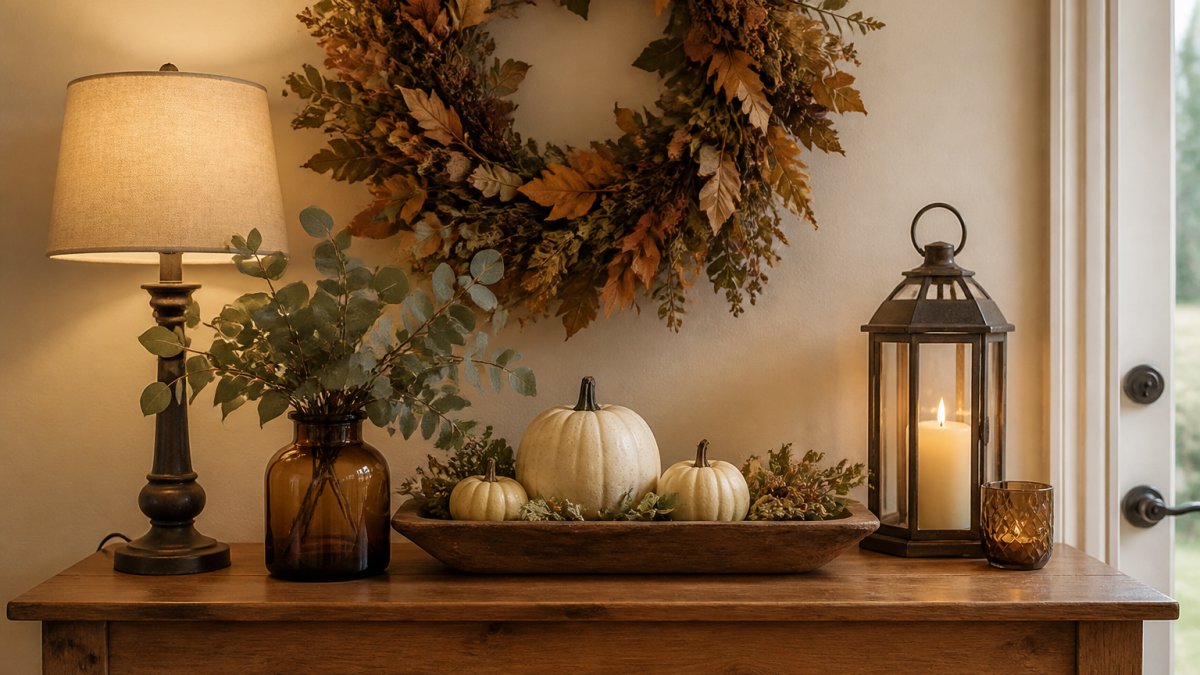
Step 1: Start with a Tray as Your Base
A tray is your organizing anchor, corralling smaller items and creating visual structure. Choose a neutral tone or natural material like wood or rattan.
Mixing finishes, like wood with metallic accents, adds interest. Place it slightly off-center for a dynamic look.
Step 2: Layer in Seasonal Accents and Greenery
Inside the tray, add white pumpkins, small gourds, or fall foliage. Eucalyptus and cotton stems bring organic texture without clutter.
Add 3-5 items maximum, leaving breathing room between them.
Let greenery spill slightly beyond the tray’s edges, drape a cotton stem or eucalyptus branch over one corner.
Step 3: Add Height and Visual Interest with Mirrors or Wreaths
Hang a mirror or wreath directly above the console table to add vertical dimension and make the entryway feel larger.
A mirror reflects light into the entryway, brightening it; a vintage or ornate frame adds character and pairs beautifully with pre-loved pieces.
Position the mirror or wreath 12-18 inches above the table surface for proper proportion.
Small Entryway Decor Ideas for Tight Spaces
Many entryways are narrow hallways, tight corners, or the sliver of wall beside a front door. These spaces require an approach that starts with layout rather than decor.
Measure before you shop: walkway width, depth from door to nearest wall, and usable wall height. Keep at least 36 inches of clear walking path, never less than 32 inches in a tight hall; if a piece would narrow it below that, choose a slimmer option or move styling to the wall.
Narrow hallway (under about 4 feet wide)
Skip the full-size console. Use a wall-mounted shelf 8 to 10 inches deep, a slim demilune table, or a floating ledge, with a mirror or wreath above and a clear floor. Add hooks at about 60 inches and a shallow boot tray; one tall vase with dried stems and one small tray for keys is enough.
Small apartment or shared entry
When the door opens into the living space, define the entry with a runner or 2-by-3-foot rug rather than furniture. Use a narrow storage bench or a wall-mounted coat rack with a shelf, and keep the palette to your warm neutral base plus one accent.
Open-plan entrance
In an open layout, the entry needs a visual boundary. A console placed perpendicular to the wall, a low bookcase as a room divider, or a pair of accent chairs defines the zone without building a wall. Style the back of any freestanding piece too; a tray on top and a basket below keep it functional.
Homes without a console table
You don’t need a table to style an entry. Alternatives that work:
- A bench with a shelf or cubbies beneath it, topped with a tray and a small lamp.
- A wall-mounted shelf paired with hooks below.
- A slim ladder shelf in a corner.
Each gives you a surface for seasonal accents while solving a storage need.
Vertical space is your best square footage
In a tight entry, draw the eye up. A tall mirror, a vertical stack of two shelves, or a high-hung wreath makes the ceiling feel farther away. Keep the lowest 12 inches of wall clear. Hooks at 60 inches, a mirror centered at 60 to 65 inches, and a shelf at 72 inches create vertical rhythm without eating floor space.
Keep the path clear
A small entryway fails when decor blocks the door swing or walkway. Check that the door opens fully, nothing sits in the path, and rugs lie flat. Style the edges, not the middle.
Before you buy anything, tape the footprint of a candidate table or bench on the floor with painter’s tape and walk through the entry for a day. If you brush the tape, the piece is too big.
At Le Rouge Tete, we display furniture in a “live in” layout, so you can see how a slim console or bench behaves in a real walkway before it comes home.
Entryway Essentials for Organization and Function
A beautiful entryway that doesn’t function is just decoration. Plan the arrival zone as a system rather than a collection of accessories.
Map the arrival sequence
Watch how guests enter: open the door, step onto a mat, set down a bag, remove a coat, then pause. Design for that sequence in order.
- Landing spot at the door. A durable mat or rug catches grit and gives guests a place to stand while they close the door. Choose a low-pile or natural-fiber mat that lies flat.
- Drop zone for bags and keys. A tray or shallow bowl within arm’s reach of the door holds keys, mail, and sunglasses. A basket or hook nearby takes bags and totes.
- Coat and shoe station. Hooks at about 60 inches above the floor work for most adults; add a lower hook at about 36 to 40 inches for children. A bench or boot tray keeps shoes off the walking path.
- Pause point. A mirror and a lamp give guests a moment to check their appearance and orient themselves before moving into the home.
Capacity: how much storage is enough
A common pattern is to plan for one hook per household member plus two for guests, and one pair of shoes per person in the active rotation. If your household has four people, that means six hooks and space for about four pairs of shoes near the door, with the rest stored elsewhere. A bench with a shelf beneath it or a lidded basket handles overflow without visual clutter.
Keep clutter off the styled surface
The console table is for display, not for daily debris. Give keys, mail, and leashes their own tray or drawer so the styled surface stays intentional. A small drawer in a vintage sideboard or a lidded box on a shelf keeps the entry looking composed even on a busy morning.
Lighting that works for arrival
Include at least one light source you can turn on before guests arrive. A small table lamp on the console, a wall sconce above the mirror, or a plug-in pendant gives warm, layered light. Warm-toned bulbs around 2700K enhance the cozy autumn feel and flatter skin tones in the mirror. Avoid relying on a single harsh overhead fixture, which flattens the space and casts shadows on faces.
Safety and accessibility
An entryway is a high-traffic zone, so stability matters.
- Anchor tall or heavy furniture to the wall with anti-tip straps, especially if children or pets are in the home.
- Keep the walking path clear of trip hazards: no trailing cords, curled rug corners, or baskets that spill into the path.
- Choose rugs with non-slip backing or add a rug pad.
A console table that wobbles or a mirror hung with a single light hook is a fall risk in a busy entry. Check anchors and hardware before the season starts, and recheck after hanging heavy wreaths or bags.
Seasonal rotation that stays functional
Design your styling so you can swap out pumpkins, greenery, and accent pieces monthly without disturbing the function. Keep the tray, lamp, and hooks in place as your foundation, and change only the seasonal layer on top.
A mirror serves double duty. It’s decorative and practical, and guests can check their appearance before entering your home.
Lighting and Natural Elements That Create a Cozy Welcome
Lighting transforms an entryway from functional to inviting.
Use multiple light sources.
Position your lamp so it illuminates your styled console table.
Natural elements reinforce the seasonal feeling. Explore cozy autumn home decor ideas that complement your entire home’s seasonal aesthetic.
Cotton stems and eucalyptus are particularly effective. They’re lightweight, long-lasting (especially faux versions), and add height without visual weight.
Consider adding a small potted mum or fall-colored plant.
Fresh pumpkins add authentic seasonal charm, but they don’t last forever.
Common Styling Mistakes to Avoid
The most common mistake is overcrowding. More pieces don’t equal better styling.
Avoid mixing too many color families.
Don’t forget about scale.
Many people neglect the wall space above their console table.
Lighting is often an afterthought. An unlit entryway, no matter how beautifully styled, feels unwelcoming.
Finally, avoid seasonal pieces that feel cheap or plastic. Pre-loved pieces from a consignment store often have more character and durability than new fast-fashion decor. Design Within Reach’s principles of intentional home styling emphasizes choosing pieces you’ll love long-term rather than trendy items you’ll discard.
Refreshing your entryway seasonally doesn’t require starting from scratch.
At Le Rouge Tete, we understand that styling your home doesn’t have to strain your budget. Our curated selection of pre-loved furniture and decor lets you create a sophisticated, layered entryway without retail prices. The Spruce’s guide to seasonal home styling reinforces that the best entryways reflect both your personal style and your home’s actual needs.
Avoid these frequent missteps when styling your fall entryway.
| Mistake | Why It Fails | Solution |
|---|---|---|
| Overcrowding | Cluttered entryway feels chaotic rather than welcoming | Use fewer, intentional pieces |
| Mixing too many colors | Space feels unfocused and busy | Stick to warm neutral base plus 2-3 accent colors |
| Ignoring scale | Pieces look awkward and unbalanced together | Choose furniture proportional to your space |
| Bare wall above console | Wastes prime real estate for visual interest | Add mirror, wreath, or artwork |
| Poor or no lighting | Beautiful styling feels unwelcoming | Invest in at least one good light source |
| Cheap or plastic pieces | Guests see entryway first; quality matters | Choose pre-loved pieces with character and durability |
Frequently Asked Questions
How do you decorate an entryway for fall without it looking cluttered?
The key is layering with intention. Use a tray as your base to contain smaller items, then add 3-5 focal pieces like pumpkins, greenery, and a mirror or wreath. Stick to a warm color palette of golds, warm neutrals, and burnt orange. Leave negative space around items so your eyes can rest, and resist the urge to fill every surface. Quality over quantity creates an elegant fall entryway that welcomes guests.
What are the best fall entryway decor ideas for small spaces?
In tight entryways, vertical styling is your friend. Hang a fall wreath on the wall or door, use a narrow console table if space allows, and add a small decorative mirror to reflect light and create depth. Choose one or two statement pieces like white pumpkins or a tall stem arrangement rather than many small items. A cozy runner rug and warm lighting make even the smallest entry feel inviting without overwhelming the space.
What entryway essentials help with organization while looking stylish?
A console table with a tray corrals keys, mail, and small items. Add a decorative container for outerwear or a basket for shoes. A mirror serves both function and style. Hooks on the wall keep coats accessible. Warm lighting from a small lamp adds ambiance while helping guests navigate safely. These functional pieces work together to create an organized, welcoming space that doesn’t sacrifice style for practicality.
Can I use real pumpkins and greenery, or should I buy faux versions?
Both work beautifully. Real pumpkins and fresh eucalyptus last 2-4 weeks and create authentic seasonal charm, perfect if you’re styling for early fall. Faux versions are durable, reusable year after year, and cost-effective for frequent styling changes. Real elements feel more organic and inviting; faux options offer convenience and longevity. Mix both for the best result: real greenery with faux pumpkins, or vice versa, to balance freshness with practicality.

