
Table of Contents
- Why Identifying Solid Wood Furniture Matters
- Solid Wood vs Veneer Furniture: Understanding the Difference
- Step 1: Inspect the Grain and End Grain
- Step 2: Check Weight, Density, and Wood Species
- Step 3: Examine Joinery and Construction Methods
- Step 4: Look for Damage, Wear, and Hidden Issues
- Step 5: Test Stability and Structural Integrity
- Best Tools for Inspecting Thrifted Furniture
Last Updated: August 29, 2026
Why Identifying Solid Wood Furniture Matters
Buying pre-loved furniture is an affordable way to furnish your home, but not all used furniture is created equal. The difference between a piece that lasts decades and one that falls apart in two years often comes down to whether you’re looking at solid wood or particleboard masquerading as the real thing.
Solid wood furniture holds its value, ages gracefully, and can be refinished or repaired when needed. Particleboard and veneer alternatives chip, sag, and deteriorate. Learning how to identify solid wood furniture at thrift stores means investing in pieces that will survive moves, daily use, and the test of time.
At Le Rouge Tete, we’ve spent over 16 years curating pre-loved furniture for homeowners, vacation rental owners, and design-conscious locals. This guide walks you through five proven steps to evaluate furniture like a pro, so you’ll have the confidence to spot genuine solid wood from cheap construction.
Solid Wood vs Veneer Furniture: Understanding the Difference
Solid wood furniture is made from actual wood throughout its structure, frame, legs, drawers, and panels all use real wood. Veneer furniture has a thin layer of real wood glued over a particleboard or plywood core. Particleboard is compressed sawdust and adhesive, often painted or stained to look like wood.
The difference matters enormously for durability and repairability. Solid wood can be sanded, refinished, and repaired indefinitely. Veneer can’t be refinished without destroying the veneer layer. Once particleboard gets wet or damaged, it swells and becomes unusable.
Veneer isn’t inherently bad, high-end furniture often uses it on large panels for stability. But veneer on cheap particleboard is a red flag. You’re paying for the look of wood without any durability benefits. Modern manufacturing has gotten very good at making particleboard and veneer look like solid wood through paint, stain, and plastic laminates. That’s where systematic inspection comes in.
Step 1: Inspect the Grain and End Grain
What consistent grain tells you
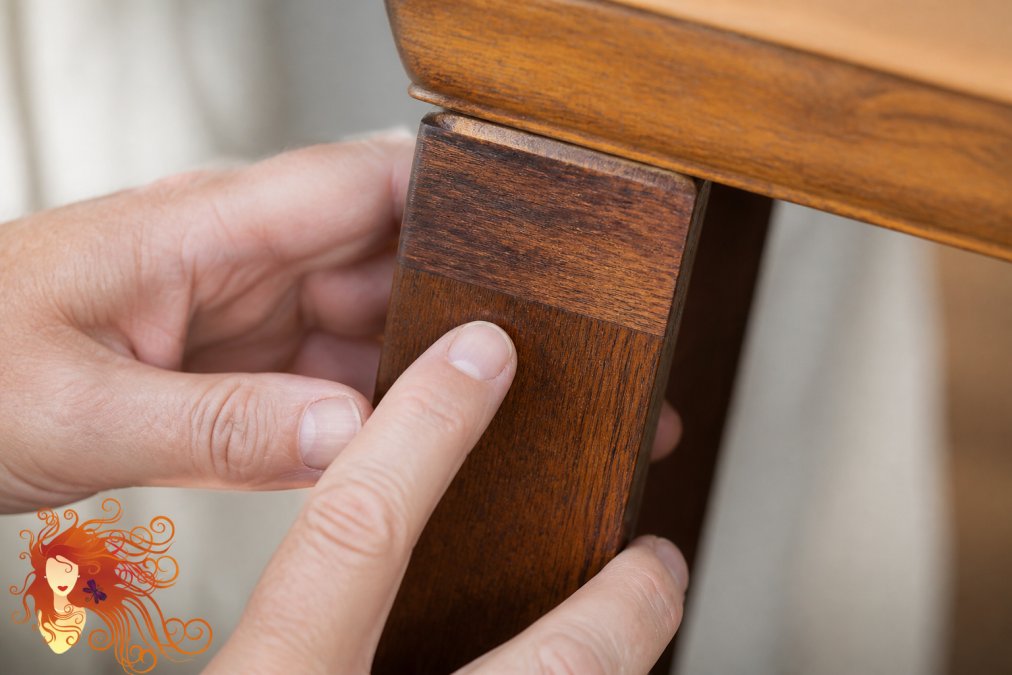
Solid wood has a consistent, natural grain pattern that flows continuously across the piece with character, variation, and a three-dimensional quality. Run your hand across the surface, solid wood grain feels natural and slightly textured, while veneer can feel smooth and artificial.
Look for grain that wraps around corners and edges. On a solid wood table leg, the grain on the front, sides, and back should all connect naturally. On veneer, the grain pattern often stops abruptly or repeats unnaturally because it’s applied as a single layer.
Why end grain is the real test
Look at the end grain, the edge of the wood where it’s been cut, showing the annual rings. Solid wood has visible end grain with distinct texture and rings. The end grain color might be slightly different from the surface, which is completely normal.
Veneer has no end grain because it’s a thin layer applied to something else. If you look at the edge of a veneered piece, you’ll see the veneer layer (usually 1-3mm), then the particleboard or plywood underneath. The particleboard edge looks compressed, uniform, and nothing like real wood.
Find end grain anywhere wood has been cut: table edges, drawer fronts, shelf edges, leg bottoms, and back panel edges. Real wood end grain has character; particleboard edges look uniform and industrial.
Step 2: Check Weight, Density, and Wood Species
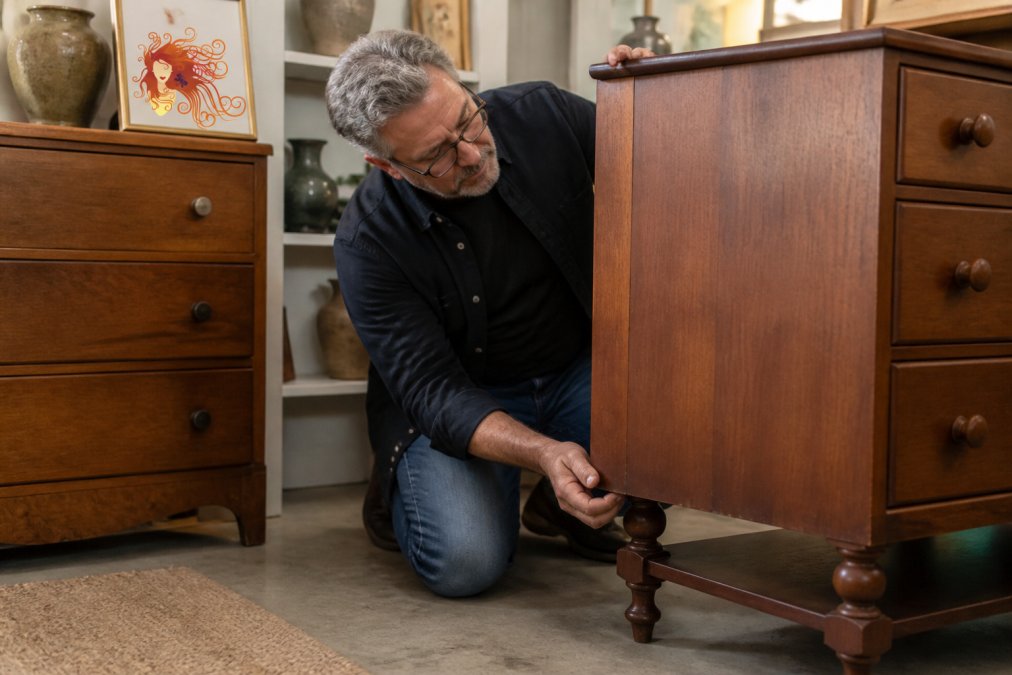
Solid wood is heavy. Pick up the piece safely, solid wood furniture feels substantial, while particleboard feels lighter and hollow by comparison. This isn’t foolproof on its own, but weight combined with other tests is a strong indicator.
Density varies by wood species. Hardwoods like oak, walnut, and cherry are denser and heavier than softwoods like pine (peer-reviewed research). Both are solid wood, but hardwoods are more durable for high-traffic pieces like dining tables and chairs. Softwoods work fine for bedroom furniture.
Learning to recognize common species helps. Oak is heavy, dense, and has distinctive grain with prominent rays. Walnut is dark, dense, and has rich, straight grain. Cherry is medium-weight with fine, even grain. Pine is lighter, softer, and more rustic. Look at color, grain pattern, and weight together, if it’s heavy, has consistent grain, and feels solid, you’re likely looking at real wood.
Step 3: Examine Joinery and Construction Methods
How a piece is assembled reveals its quality. Cheap furniture uses staples, nails, and glue. Quality furniture uses joinery, methods that lock wood pieces together without relying on fasteners.
Dovetail joints and mortise and tenon connections
Dovetail joints are the gold standard. Look at drawer corners, especially inside where the drawer front meets the sides. A dovetail joint has interlocking, wedge-shaped cuts that fit together like puzzle pieces. Dovetails require precision cutting and fitting.
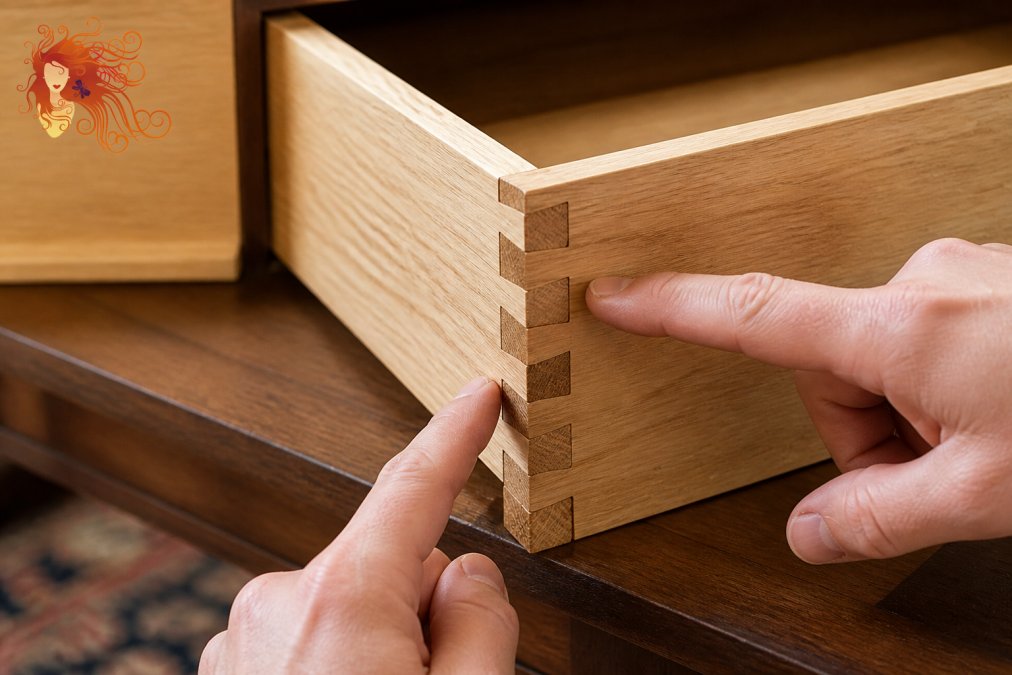
Mortise and tenon joints are another sign of quality. A mortise is a rectangular hole cut into one piece of wood; a tenon is a rectangular projection that fits into it. These joints are incredibly strong and were the standard in furniture making for centuries. You’ll see them where table legs meet the frame, where chair arms connect to the back, and where cabinet sides meet the top.
Look inside drawers, under tables, and at chair undersides. If construction is visible and uses actual joinery, that’s solid wood furniture. If you see staples, nails, and particleboard, you’re looking at cheap construction.
What cheap construction looks like
Budget furniture uses staples to attach the back panel to the frame. Drawers are often assembled with nails or staples and glue, with no joinery. The bottom of drawers is frequently thin plywood or hardboard, not solid wood. A drawer held together with staples will eventually come apart.
Step 4: Look for Damage, Wear, and Hidden Issues
Even solid wood furniture can have problems. Identify damage that’s cosmetic versus structural.
Water rings, warping, and surface damage
Water rings are white or dark circular marks where a wet glass sat on wood (extension.oregonstate.edu). These are cosmetic and usually removable. Warping is different, if a tabletop is visibly curved or twisted, or if drawer fronts don’t sit flush, that’s structural damage. Warped particleboard is permanent.
Run your hand across surfaces to feel for dents, gouges, and scratches. On solid wood, these are repairable. On veneer or particleboard, gouges that penetrate the surface are often permanent.
Checking underneath, inside drawers, and the back
Flip the piece over or get underneath it. This is where manufacturers cut corners. On solid wood furniture, the underside looks like wood. On veneer or particleboard, you’ll see the core material, staples, nails, and cheap fasteners.
Check inside drawers carefully. Are joints dovetailed or mortise and tenon, or are they stapled and glued? Look at the drawer bottom, is it solid wood or thin plywood? Pull drawers out completely if possible. Solid wood drawers slide smoothly on wooden runners or metal slides.
Pest damage and musty odors
Smell the piece. A musty odor can indicate water damage, mold, or pest infestation. Look for small holes, sawdust, or tunneling in the wood, signs of woodworm, termites, or other wood-boring insects. This damage is structural and typically not worth the risk. Check corners, joints, and undersides where pests are most likely to hide.
Step 5: Test Stability and Structural Integrity
Sit on chairs and benches, they should feel solid. If they wobble, creak, or shift under your weight, something is loose or broken. Push on the sides of tables and cabinets. They should be rigid. If they flex or twist out of square, the frame is compromised.
Open and close drawers multiple times. They should glide smoothly and close fully without sticking. Check table legs and chair legs for cracks or splits. Small surface cracks in solid wood are often cosmetic, but deep cracks along the grain can be structural failures. Gently pull on chair arms and backs, they should be solid.
Best Tools for Inspecting Thrifted Furniture
You don’t need much to inspect furniture effectively. A flashlight or headlamp is essential for seeing inside drawers and under furniture. A magnifying glass helps you examine joinery and grain patterns. A small ruler or measuring tape lets you check drawer dimensions and assess veneer thickness. A moisture meter (optional) detects moisture in wood if a piece feels damp or smells musty. A notebook helps record observations when evaluating multiple pieces.
Most importantly, bring time. Spend 5-10 minutes on each piece you’re seriously considering. Open every drawer, look at every edge, sit on it, and really examine the construction.
When you shop at Le Rouge Tete, our team has already done much of this work for you. Every piece in our store has been inspected for quality and condition. Our 16 years of experience means we know solid wood when we see it. We display furniture in a "live in" layout so you can visualize pieces in your own space and test them out before you commit. If you have questions about construction or condition, our staff can walk you through what you’re looking at.
Finding solid wood furniture at thrift stores is entirely learnable. The steps above give you a systematic way to evaluate any piece. At Le Rouge Tete, we’ve already filtered for quality, condition, and construction. You get access to solid wood pieces that have been properly evaluated, displayed to show them off, and backed by our commitment to customer satisfaction. Whether you’re furnishing a new home, stocking a vacation rental, or hunting for that perfect vintage find, we make the process seamless. Contact us to explore our current inventory or discuss consignment options.
Frequently Asked Questions
Q: How can I tell if furniture is solid wood or veneer?
A: Check the edges and end grain first. Solid wood shows consistent grain patterns throughout and has visible wood grain on all sides, including edges. Veneer appears as a thin decorative layer over a base material, often with mismatched grain patterns where pieces meet. Look at the underside and back of the piece, solid wood construction shows wood throughout, while veneer typically reveals particleboard or plywood underneath.
Q: What are the best tools for inspecting thrifted furniture?
A: You need a flashlight to examine dark corners and joints, a magnifying glass to spot damage and wood grain details, and a moisture meter to detect hidden water damage. A small awl or ice pick helps test wood density by gently probing inconspicuous areas. A level checks if drawers and doors hang straight, and a tape measure verifies dimensions before purchase. These basic tools can help reveal structural issues that visual inspection alone misses.
Q: How do I know if wood furniture is worth refinishing?
A: Solid wood with sound joinery and good structural integrity is worth refinishing. Check that the frame is square, joints are tight, and there's no pest damage or deep rot. Veneer furniture is typically not worth refinishing since the veneer can peel or bubble during the refinishing process. Assess the wood species and construction quality, high-quality hardwoods like oak, walnut, or cherry can justify refinishing investment, while particleboard or low-grade plywood may not.
Q: What signs indicate high-quality solid wood furniture?
A: Quality solid wood furniture shows consistent grain patterns, proper joinery like dovetail joints or mortise and tenon connections, and substantial weight relative to size. Look for solid wood construction throughout, including the back and underside. Drawer slides should operate smoothly, and there should be no gaps between joints. Avoid pieces with water rings, warping, bubbling finishes, or structural wobbling, as these suggest poor quality or damage.
This article was written using GrandRanker