
Last Updated: November 2, 2026
Quick Summary
To transport large furniture to a consignment shop, get the piece approved first by calling the shop and sending photos, then empty drawers, remove hardware, disassemble what comes apart, and wrap every edge before loading. Measure the piece against your vehicle’s cargo opening, secure it with ratchet straps over padding, and confirm the split and any pickup fees in writing before you haul it.
- Call the shop and send photos before you lift anything, since approval comes first.
- At Le Rouge Tete the split is 50/50 with no end date on consignments.
- Empty every drawer, remove hardware, and bag screws before the piece leaves the house.
- Pad every strap contact point, because a bare wood edge can take a compression mark.
- Le Rouge Tete offers $50 local pickup for large items, which often beats a rental.
Table of Contents
- What Consignment Shops Require Before You Haul a Piece
- How to Move Heavy Furniture Safely: Prep and Disassembly
- Protective Materials That Prevent Transit Damage
- How to Transport Furniture Without a Truck
- Securing the Load: Straps, Ratchets, and Tie-Down Points
- Furniture Pickup and Delivery: When to Let the Pros Handle It
- Cost to Transport Large Furniture: What Drives the Price
- Booking Your Consignment Drop-Off or Local Pickup
- Frequently Asked Questions
What Consignment Shops Require Before You Haul a Piece
Most sellers lose money before the piece ever reaches the sales floor. They haul a heavy dresser across town, then learn the shop won’t take it.
Consignment furniture transport starts with approval, not a truck. A consignment agreement is a contract: the shop displays your piece, sells it, and pays you a share. That share is usually a split, and the terms vary by shop.
Inspection Standards and the 50/50 Split
Consignment shops generally inspect items before accepting them. Sellers should expect staff to check:
- Structural soundness: joints, legs, drawer glides, and frames
- Furniture condition: scratches, water rings, stains, and odors
- Function: doors that close, drawers that slide, hardware that works
At Le Rouge Tete, our split is 50/50, and we set no end date on consignments. Ask about end dates and fees in writing before you commit to any shop.
How to Move Heavy Furniture Safely: Prep and Disassembly
Preparation decides whether the move goes smoothly or ends in a repair bill. Strip the piece down before it leaves the house, and label every part.
Here’s our prep sequence:
- Empty every drawer and shelf. Weight adds up fast, and loose items shift in transit.
- Remove hardware. Bag screws, bolts, and handles, then tape the bag to the piece.
- Disassemble what comes apart. Legs, headboards, and table tops usually detach.
- Photograph the assembly. You’ll want the reference when it’s time to rebuild.
- Clean and touch up. A wiped-down piece photographs better and sells faster.
Lifting is where backs get hurt. Keep the load close to your body, bend at the knees, and avoid twisting while carrying. If floors are a concern, our guide on moving heavy furniture without floor damage covers padding and slider techniques in detail.
Protective Materials That Prevent Transit Damage
Transit damage can reduce a piece’s resale value. Wrap furniture carefully before it moves.
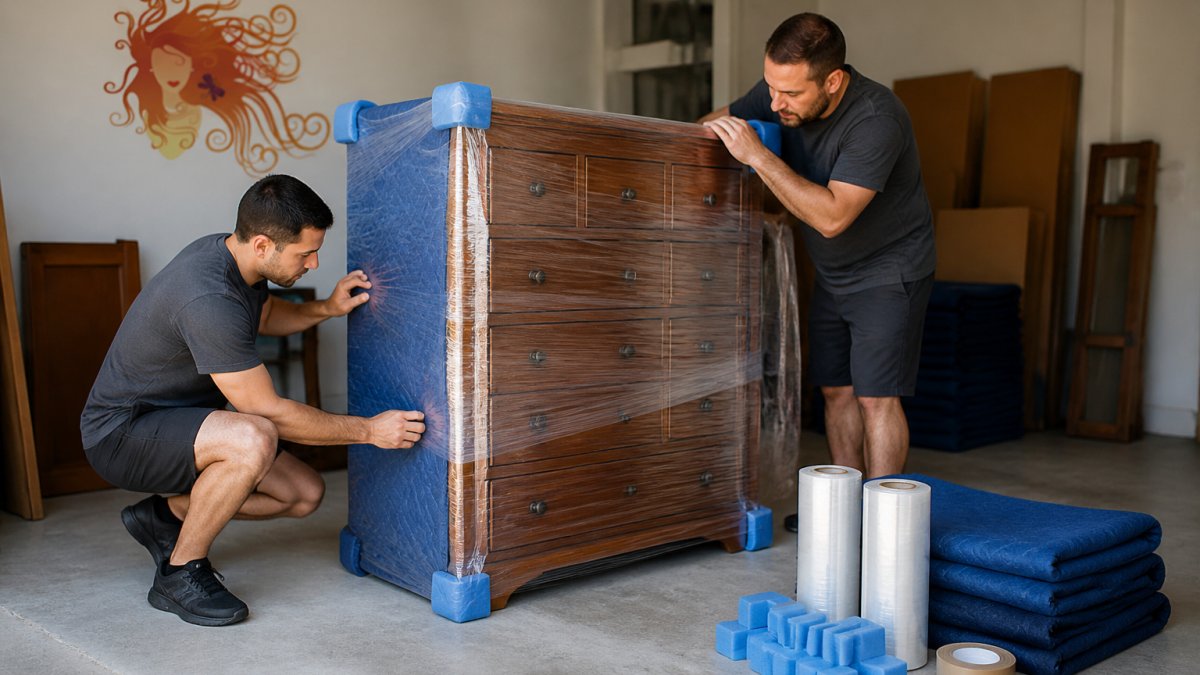
The basic kit:
- Moving blankets for overall coverage
- Blanket wrapping or stretch film to hold padding in place
- Corner protectors on every edge that touches a surface
Wrap drawers shut and tape them closed. Pad glass and mirrors on both faces, then stand them upright, never flat.
How to Transport Furniture Without a Truck
No truck? You have more options than you think. Knowing how to transport furniture without a truck comes down to matching the piece to the vehicle.
Measure twice, rent once. Grab the piece’s dimensions and the cargo opening of the vehicle before you commit.
| Option | Best For | Watch Out For |
|---|---|---|
| Cargo van rental | Dressers, small sofas | Weight capacity limits |
| Pickup truck rental | Bulky single items | No weather protection |
| Trailer + hitch | Multiple pieces | Towing experience needed |
| Borrowed SUV | Chairs, side tables | Door height clearance |
| Delivery service | Anything heavy | Scheduling windows |
A furniture dolly and a loading ramp turn a two-person nightmare into a one-person job. Strap the dolly load down, and use a ramp instead of lifting where possible.
Securing the Load: Straps, Ratchets, and Tie-Down Points
A loose load is a hazard, not a shortcut. Secure every piece as if you will hit a hard stop, because you might. For consignment sellers, load securing is also a resale-value decision: a strap that bites into a finished surface or a piece that shifts and gouges a corner can get the item rejected at intake or knock down its selling price.
Load Securing Basics
- Heavy items go low and forward, over or ahead of the axle.
- Use four tie-down points where possible, two per side, so the piece cannot rotate.
- Ratchet straps beat rope every time. Rope stretches; ratchets do not.
Consignment-Specific Securing
Standard moving advice stops at “it did not fall off the truck.” Consignment requires a higher bar: the piece must arrive in the same condition it left your house, because the shop’s intake inspection is the gatekeeper for your payout.
- Pad every contact point, not just the corners. Straps, the truck bed, and adjacent pieces all create rub points. Wrap the whole piece, then strap over the wrap.
- Strap the piece to the vehicle, not to another piece. Strapping furniture to furniture lets one shift take both down.
- Keep glass and mirrors upright and separated. Pad both faces, stand them vertically, and never lay them flat under other load.
Watch out: a strap tightened over a bare wood edge will leave a compression mark that shows up under the shop’s inspection light. Pad first, then tension.
Who Pays If It Breaks: Liability and Insurance
This is the question most moving guides skip, and it is the one that matters most when a third party hauls your furniture to a consignment shop.
- If you haul it yourself: You are the insurer. Your auto policy may cover the vehicle, but it typically does not cover the cargo. Check your homeowner’s or renter’s policy for off-premises coverage before you assume you are protected.
- If you hire a local mover: Ask for a certificate of insurance before they load a single piece. Confirm whether the coverage is liability (they pay if they damage your piece) or released-value (a lower default payout based on weight, not value). For high-value antiques, ask about declared-value coverage and get the number in writing.
- If the shop picks it up: Confirm in writing who carries the risk between your door and the shop’s floor. A shop pickup is convenient, but the liability terms should be stated on the pickup receipt, not assumed.
Load securing is also a legal matter. The Federal Motor Carrier Safety Administration cargo securement rules spell out what counts as an adequately secured load. If you are weighing whether to hire out at all, our local guide on hiring professional furniture movers covers what to ask before you book.
Furniture Pickup and Delivery: When to Let the Pros Handle It
Some pieces should never touch your truck bed. If the item is oversized, fragile, or worth more than the cost of hiring help, call a pro.
Signs it’s time to hire out:
- The piece won’t fit through your door without disassembly you can’t reverse
- It’s a piano, marble top, or antique with veneer
- You’d need three people and a stair climb
Professional furniture movers typically carry insurance and equipment for moves. If you’re weighing the decision, our local guide on hiring professional furniture movers walks through what to ask before you book.
Liability matters here. Ask any third-party transporter about their insurance coverage before they load your furniture.
Cost to Transport Large Furniture: What Drives the Price
The cost to transport large furniture depends on distance, size, access, and labor, not a flat rate. Two dressers of similar size can still cost different amounts to move. For consignment sellers, the number that matters is not the transport bill, it is the transport bill measured against your expected payout. A move that costs more than a piece will net you after the split is a poor trade.
The Four Cost Buckets
Every local transport quote in the Morehead City area breaks down into the same four buckets. Ask any mover or rental counter to price each one separately so you can compare apples to apples.
- Distance and time: Local moves are often billed by the hour, sometimes with a minimum, rather than by the mile. Pricing depends on distance, the size and weight of the piece, access, and timing; contact Le Rouge Tete or your mover for a current quote.
- Weight and size: A queen dresser and a marble-top sideboard are not the same job even if they are the same footprint. Heavy pieces require more people, more padding, and sometimes a stair dolly.
- Access: Stairs, tight hallways, elevator waits, and long carries from the door to the truck add labor minutes. A ground-floor garage load-out is the cheapest access scenario; a third-floor walk-up is the most expensive.
Rental vs. Hired Help vs. Shop Pickup
There are three ways to pay for the move, and they are not interchangeable.
- DIY rental: A cargo van or pickup rental plus fuel plus your own labor. Cheapest on paper, but the clock starts when you pick up the keys and you pay for the return trip and cleaning.
- Hired local movers: Hourly labor with a minimum, plus a truck fee. More expensive per hour, but they carry insurance and equipment, and they finish faster.
- Shop pickup: Some consignment shops offer local pickup for large items. At Le Rouge Tete, our flat $50 local pickup for large items frequently beats a rental plus gas plus a sore back, especially for a single oversized piece.
How to Sanity-Check a Quote
A quote that does not mention stairs, disassembly, or the return trip is not a quote, it is a guess. Ask for the scope in writing: what is included, what triggers an extra charge, and what the cancellation window is.
Watch out: a low hourly rate with a four-hour minimum can cost more than a higher rate with a two-hour minimum on a short local run. Do the math on total job cost, not the headline rate.
The Consignment Math
Before you book anything, run the payout math. Confirm the split and the payout timeline with the shop first, then subtract the transport cost from your expected share. If transport eats a large share of your expected payout, consider whether shop pickup or another selling route makes more sense. Our guide on how to consign furniture walks through the split and payout timeline in more detail.
Booking Your Consignment Drop-Off or Local Pickup
Booking ahead helps keep your schedule organized for drop-off or pickup.
Before you book, confirm:
- The item passed inspection and you have approval in writing
- You know the split and the payout timeline
- Pickup fees, if any, are stated upfront
Want the full rundown on how consigning works from start to finish? Read our beginner’s guide on how to consign furniture. Not sure your oversized piece qualifies? Check with the shop before you load the truck. And when you’re ready to schedule, our page on consignment furniture pickup in Morehead City shows how local pickup works.
Frequently Asked Questions
Do furniture consignment shops pick up large items?
Some do, and it is worth asking before you rent a truck. Le Rouge Tete offers convenient $50 local pickup for large items in the Morehead City area, which saves you the loading, strapping, and driving. Confirm the item has been accepted for consignment first, then schedule the pickup.
How do I protect furniture while transporting it?
Wrap each piece in moving blankets and secure them with stretch wrap so the padding does not slide off. Tape corner protectors onto edges and legs, remove drawers and glass, and bag the hardware so nothing gets lost. Never lay a piece on its side for a long drive if it has a loose frame or marble top. Blanket wrapping plus load securing with straps keeps transit damage to a minimum.
What is the best tool for moving heavy furniture?
A furniture dolly and a loading ramp do most of the work. A four-wheel dolly handles dressers and cabinets, while furniture sliders let you glide pieces across floors without lifting. For pickup trucks and cargo vans, a ramp reduces the lift height at the tailgate. Add ratchet straps to lock the load in place. These tools cost far less than a back injury and make solo moves realistic.
What should I ask a consignment shop before bringing in furniture?
Ask about their inspection standards, the commission split, whether there is an end date on the consignment, and how pickup works for large pieces. Le Rouge Tete uses a 50/50 split with no end dates, Also ask what condition they require and whether they help unload, since a few minutes on the phone prevents a wasted trip across Carteret County.
Transporting large furniture to a consignment shop doesn’t have to cost you a weekend or a repair bill. The right prep, the right wrap, and the right help make the difference. At Le Rouge Tete, we’ve served the Crystal Coast for over 16 years with a 50/50 split, no end dates, and a flat $50 local pickup for large items. Our “live in” store layout helps you see how a piece fits before you commit. Get started with Le Rouge Tete and turn that spare bedroom into cash.
