
Last Updated: November 8, 2026
Quick Summary
Consigning antique furniture safely means signing a written agreement that sets the commission split, agreed price, floor price, term, pickup deadline, and damage responsibility before you hand over a piece. Build a dated condition report with photos of every flaw, and confirm in writing who insures consigned goods while they sit on the shop floor.
- Le Rouge Tete uses a straight 50/50 split with no end dates, so pieces stay until sold.
- Photograph all four sides, every drawer, veneer edges, legs, and existing flaws for the condition report.
- Set a starting price near the middle of the range of three to five comparable sold pieces.
- Ask whether the shop insures consigned property or only inventory it owns, and get it in writing.
- Large items qualify for local pickup in the Morehead City area at a flat $50 fee.
Table of Contents
- Why Consignment Beats a Garage Sale for Antique Furniture
- What Your Antique Furniture Consignment Agreement Should Cover
- Building an Antique Furniture Condition Report Before Drop-Off
- How to Price Antique Furniture for Consignment
- Antique Furniture Consignment Insurance and Damage Responsibility
- Preparing and Transporting Antique Pieces Without Damage
- Finding the Right Consignment Shop in Morehead City and Carteret County
- Booking Your Consignment Appointment at Le Rouge Tete
- Frequently Asked Questions
Why Consignment Beats a Garage Sale for Antique Furniture
Consigning antique furniture safely starts with choosing the right sales channel. A garage sale puts your pieces on a driveway for a few hours.
That difference matters for antiques. Casual bargain hunters show up on Saturday morning expecting rock-bottom prices.
At Le Rouge Tete, we have served Morehead City, NC for over 16 years.
Here is the honest comparison:
- Garage sale: fast, but you accept whatever the first wave of buyers offers.
- Online marketplace: wide reach, but you handle photos, messages, no-shows, and hauling.
- Consignment: the shop handles display and buyers while you keep ownership until it sells.
For a deeper side-by-side, see our breakdown of consignment versus garage sales and which pays more.
What Your Antique Furniture Consignment Agreement Should Cover
An antique furniture consignment agreement is a written contract that sets the split, the price, the term, and who is responsible for damage. Read it before you hand over a single piece.
Our policy is a straight 50/50 split, and we set no end dates, so your piece stays on the floor until it sells.
Terms to Read Before You Sign
Check these lines on any agreement:
- Commission split: what percentage goes to the shop.
- Agreed price: the starting price and who can lower it.
- Price reductions: how often, and by how much.
- Term and end date: when the contract expires and what happens after.
Watch out: some agreements let the shop discount your piece repeatedly without asking. A piece marked down again and again quietly erodes your payout. Ask for a floor price in writing.
Before signing, confirm the agreement addresses each of these terms in writing.
| Term | What to check |
|---|---|
| Commission split | What percentage goes to the shop |
| Agreed price | Starting price and who can lower it |
| Price reductions | How often and by how much |
| Term and end date | When the contract expires and what follows |
| Pickup deadline | How long you have to collect unsold items |
| Storage fees | Whether the shop charges past the deadline |
| Damage and loss | Who pays if a piece is scratched, broken, or stolen |
| Payment timing | When you get paid after a sale |
Building an Antique Furniture Condition Report Before Drop-Off
An antique furniture condition report is a dated record of every flaw on a piece before it leaves your home. It protects both sides if a dispute comes up later.
Build yours the same day you plan to move the piece. Good light, a clean surface, and 20 minutes are enough.
Photos and Notes That Protect You
Photograph and note these areas:
- All four sides, plus top and bottom
- Every drawer, opened, inside and out
- Door fronts, hinges, and hardware
- Veneer edges and corners for lifting or chips
- Legs and feet for splits or repairs
Write one line per flaw with its location. “Water ring, top left corner, about the size of a coaster” beats “some wear.”
A common mistake is photographing only the good side. The flaws are what the report exists to record.
How to Price Antique Furniture for Consignment
Pricing comes down to three things: what similar pieces actually sell for, the condition, and the maker. Asking prices mean little. Sold prices are the signal.
Start by searching completed sales for the same style and era. Then adjust for your piece’s flaws from the condition report. A signed piece or a known maker can carry a higher price. A repaired leg pulls it down.
A Workable Pricing Method
A practical approach most sellers can follow in an afternoon:
- Find three to five comparable sold pieces. Match on form, era, wood, and approximate size. Ignore asking prices and listings that never sold.
- Set a market range. Note the low and high sold prices for those comparables.
- Adjust for condition. Use your condition report to move within that range. Serious flaws, prior refinishing, or missing hardware push toward the low end; original finish and documented provenance push toward the high end.
- Set a starting price near the middle of the range. A price at the very top of the range tends to sit, and a piece that sits gets discounted anyway.
- Set a floor in writing. The floor is the lowest price you will accept. Put it in the agreement so markdowns cannot quietly drop below it.
How Markdowns Erode Payout
This is the part sellers underestimate. A shop that discounts a piece repeatedly without asking changes your payout even though the commission split never moves.
Ask the agreement to state how often a piece may be marked down, by how much, and whether your consent is required below a certain point. A floor price in writing is the simplest protection.
Pricing Authority and the Agreement
The pricing section of a consignment agreement should answer three questions: who sets the starting price, who may lower it, and how far. If the agreement is silent, assume the shop has broad discretion. Read those lines together with the commission, term, and pickup terms, because a low floor combined with unlimited markdowns is the combination that most often disappoints sellers.
Watch out: an overpriced antique does not just sit. It sits, gets marked down, and then sells at a discount that looks like a failure to every later buyer who sees the reduced tag.
For a step-by-step method, read our guide to pricing used furniture for consignment.
Antique Furniture Consignment Insurance and Damage Responsibility
Antique furniture consignment insurance is the coverage question sellers ask about most, and it deserves a straight answer. Ask the shop in writing who insures items on the floor and what happens if a piece is damaged, stolen, or lost in a fire.
The reason this matters is that a consignment shop is holding your property, not buying it. Until a piece sells, you still own it.
What to Verify in Writing
Get the answers to these before you sign, and have them written into the agreement rather than promised verbally:
- Who insures consigned goods. Ask whether the shop carries coverage for consigned property or only for inventory it owns. A shop that carries only its own inventory is telling you the risk stays with you.
- The basis of valuation. Coverage may be based on the agreed consignment price, a depreciated value, or a wholesale estimate. These can differ by a wide margin on a signed or rare piece, so confirm which figure the policy uses.
- The deductible and who pays it. A policy with a high deductible can leave a small claim effectively unpaid.
- Exclusions. Fire, theft, water damage, and damage during a customer’s in-home trial are often treated differently. Ask which perils are excluded.
- Who pays for repair. If a piece is scratched or a leg is broken on the floor, the agreement should say whether the shop repairs it, pays you for the damage, or returns it as-is.
How a Damage Claim Usually Works
A common pattern is that the seller reports the damage in writing, the shop documents it against the intake condition report, and the insurer or shop then determines value.
Keep your own copy of the condition report, the signed agreement, and photos of the piece on the floor. If a dispute arises, those three documents carry more weight than any conversation.
Watch out: a verbal assurance that “we’re covered” is not coverage.
When the Risk Is Not Worth It
If a shop carries no coverage for consigned goods and will not put damage responsibility in writing, the safer path may be a different channel. A specialist dealer who buys outright takes ownership and the risk with it, and an auction house typically insures consigned property as part of its terms. Neither is automatically better on price, but both shift the loss risk away from you.
Preparing and Transporting Antique Pieces Without Damage
Antique damage often happens in the move, not on the sales floor.
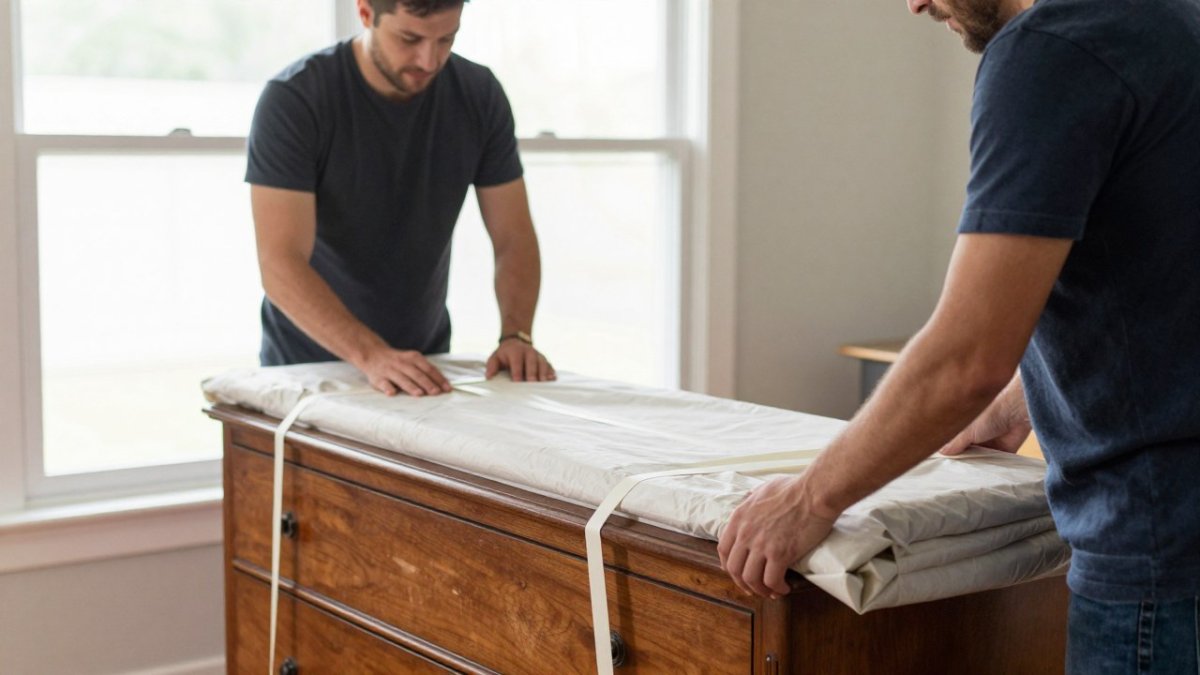
Prep the piece at home first:
- Empty every drawer and remove loose shelves.
- Remove glass, mirrors, and hardware that lifts off.
- Wrap corners and edges with moving blankets or foam.
- Tape drawers shut with painter’s tape, never packing tape.
- Strap the piece upright so it cannot tip.
- Pad between stacked items so they do not rub.
Lift from the frame, never from a drawer pull or a decorative arm. Those parts snap.
Watch out: never drag a piece across pavement or a truck bed. One scrape across a veneered edge can cost more than the piece is worth.
For a full walkthrough, use our step-by-step guide to transporting heavy furniture safely.
Finding the Right Consignment Shop in Morehead City and Carteret County
Choosing the right shop matters more than most sellers expect.
Ask these questions on your first visit:
- What is the commission split?
- Is there an end date on consignments?
- How are items displayed?
- How often are pieces discounted?
- How and when do sellers get paid?
A shop that answers all six without hesitation is worth your time. A shop that dodges the discount and pickup questions is not.
If you are searching for a consignment shop near me in Carteret County, visit in person. Look at how pieces are arranged.
For a local walkthrough, read our seller’s guide to consigning furniture in Morehead City.
Booking Your Consignment Appointment at Le Rouge Tete
Booking is simple, and we handle the heavy lifting for large items with local pickup in the Morehead City area.
Here is how it works:
- Call or message us with a few photos of your piece.
- We review the photos and confirm whether it fits our current floor.
- We set a drop-off or pickup time.
- We complete the condition report together at intake.
- Your piece goes on display, and you get paid when it sells.
Large items qualify for local pickup at a flat $50 fee, so you do not have to haul a dresser across town yourself.
Ready to move a piece out of the garage and onto our floor? Follow our step-by-step consignment pickup guide to schedule your appointment.
Consigning antique furniture safely comes down to paperwork, prep, and the right shop.
Frequently Asked Questions
What should I check before consigning antique furniture?
Inspect every piece for loose joints, veneer lifting, water rings, and odor before you commit. Photograph all sides, note existing scratches and repairs, and confirm the shop’s inspection process. Ask whether they clean or repair items and who pays for that work. A written condition report signed by both parties protects you if a dispute comes up later about damage that was already there.
How is antique furniture priced for consignment?
Pricing starts with recent sold comps for the same maker, style, and condition, not asking prices on listing sites. Condition, rarity, provenance, and current demand all shift the number. Ask how markdowns work and whether you can approve any price reductions before they happen.
Who is responsible if antique furniture is damaged while on consignment?
Responsibility depends on the consignment agreement. Read the damage clause carefully: some shops carry insurance that covers items in their care, others state they are not liable for minor wear or accidents. Ask for the policy in writing and confirm whether your homeowner’s policy still covers the piece once it leaves your home. Document condition at drop-off so any later claim is based on evidence, not memory.
How long does antique furniture usually stay on consignment?
Timelines vary by shop and by how the agreement is written. Some contracts set a fixed term, such as 60 or 90 days, then require pickup or automatic markdowns. Others, like Le Rouge Tete, set no end date and keep items on the floor until they sell. Ask about the term, markdown schedule, and pickup policy before you sign so there are no surprises.
