
Table of Contents
- Why How to Choose Pre-Loved Furniture Matters
- What You’ll Need Before You Shop
- Inspecting Used Furniture for Structural Integrity
- Identifying Quality Craftsmanship in Pre-Loved Pieces
- Chemical Safety and Digital Authentication Tools
- Where to Buy Used Furniture and What to Expect
- Your Pre-Loved Furniture Inspection Checklist
- Repair, Restoration, and Cost-Benefit Analysis
How to Choose Pre-Loved Furniture: A Complete Guide
Last Updated: July 28, 2026
Why How to Choose Pre-Loved Furniture Matters
Learning how to choose pre-loved furniture requires a shift in mindset. At Le Rouge Tete, we’ve watched thousands of customers transform their spaces by treating pre-loved furniture selection with the same rigor they’d apply to new purchases. The difference? They end up with better-quality pieces at half the price, and they actually know what they’re buying before it arrives.
Walking into a consignment store or scrolling through online listings without a framework means you’ll miss exceptional pieces or accidentally buy furniture with hidden damage that costs more to fix than the piece is worth. Below, we’ll show you exactly how to inspect, evaluate, and negotiate for pre-loved furniture like someone who understands construction, materials, and real value.
What You’ll Need Before You Shop
Preparation separates successful furniture hunters from frustrated ones. Bring these items every time you shop:
Essential Tools and Documentation
- Flashlight or headlamp: Inspect joints, undercarriages, and hidden corners where damage hides.
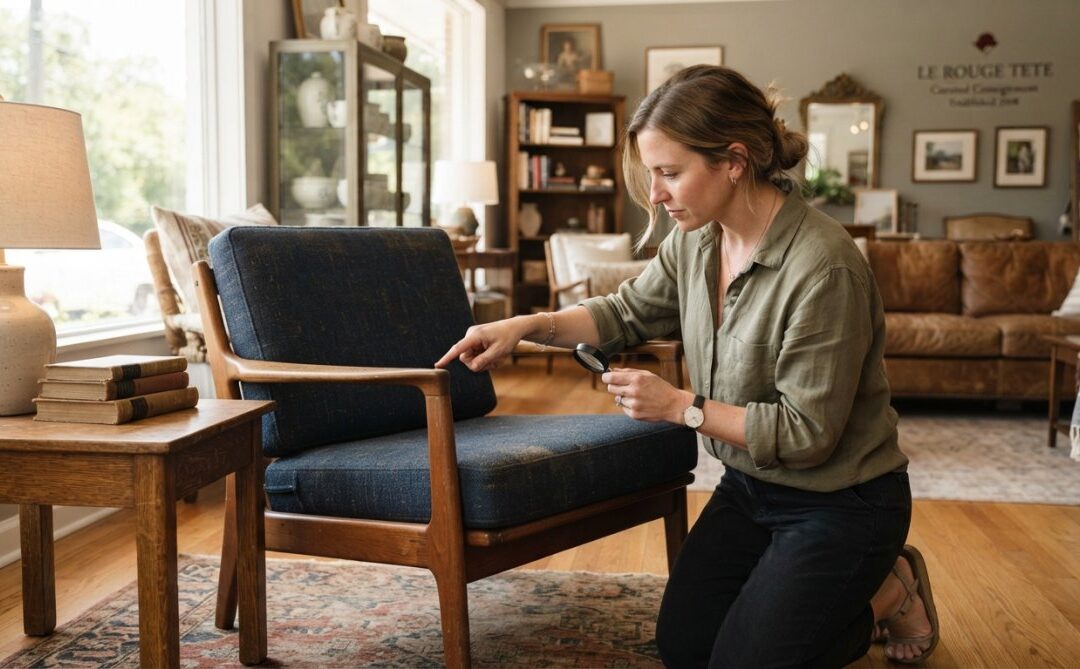
- Magnifying glass: Spot bed bugs, mold spores, or woodworm damage. A basic 10x magnifier costs less than $10.
- Measuring tape (at least 25 feet): Measure height, width, depth, and seat height for chairs. Write measurements down immediately.
- Notebook and pen: Document each piece with photos, dimensions, condition notes, and asking price.
- Phone camera: Take photos from multiple angles, including close-ups of joints and any damage.
- Moisture meter (optional but valuable): Detects hidden water damage. Costs $15-30 and catches problems that could ruin your floors.
Measuring and Photography Tips
Take at least five photos per item: full view from the front, side profile, top surface, underside, and close-ups of joints or damage. Use natural light whenever possible. For chairs, measure seat height, seat depth, back height, and arm height. For tables, measure top dimensions, leg spacing, and apron clearance. Write measurements directly in your phone’s notes app.
Inspecting Used Furniture for Structural Integrity
Structural integrity determines whether a piece will last five years or five months. A beautiful chair with a cracked frame will collapse under you. A dresser with water-damaged drawers will stick and warp further.
Frame and Foundation Assessment
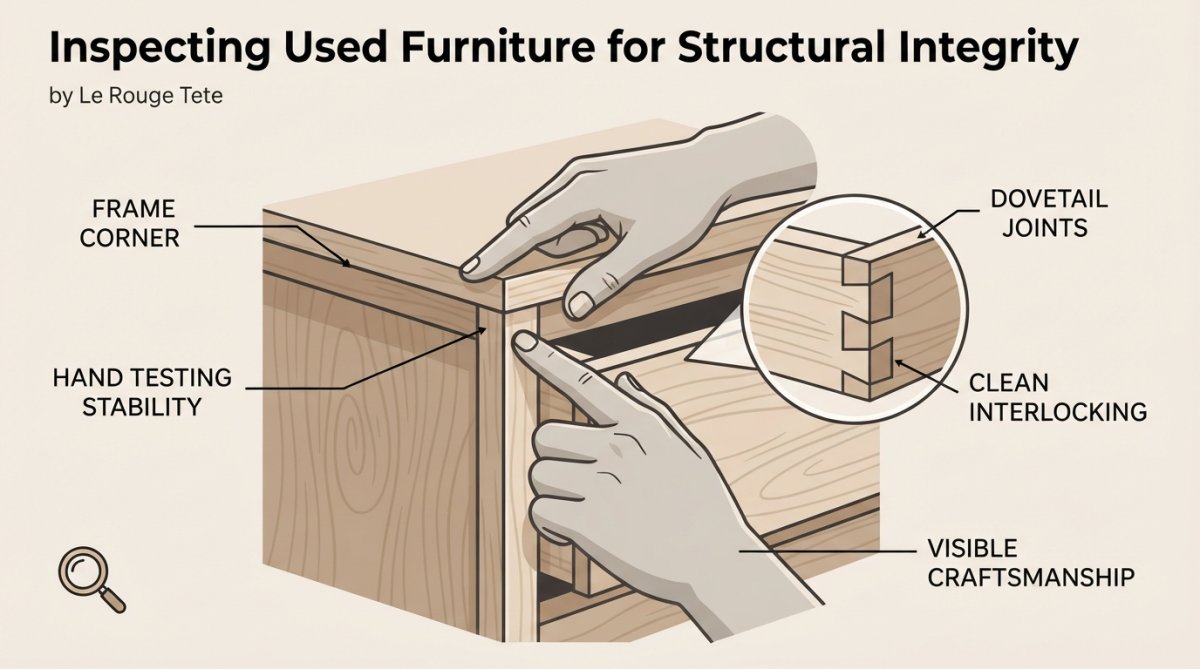
Flip the piece over or tilt it to inspect the underside. Look for cracks, splits, or signs of previous repairs. Run your hand along all joints, you should feel no movement or flexing. If the frame rocks or creaks when you apply pressure, the joints are failing.
Check the legs for straightness. Bowed legs indicate the piece has supported weight unevenly or been exposed to moisture. For upholstered pieces, press firmly on the frame from different angles. You should feel solid resistance, not give. Look for signs of previous repairs like wooden dowels, metal brackets, or newer wood patches, which suggest the original damage was severe.
Checking Joints, Hardware, and Drawer Glides
Dovetail joints are the gold standard in wooden furniture construction. Run your fingers along the joints, they should be tight with no visible gaps. Examine all hardware: hinges, drawer pulls, locks, and metal brackets. Open and close each drawer slowly. It should move smoothly without sticking, binding, or grinding sounds. If a drawer sticks, check for water stains or warping on the drawer box itself.
Signs of Water Damage, Mold, and Odors
Water damage is the most common deal-breaker in pre-loved furniture. Look for water stains on the underside and legs. Press gently on these areas with your fingernail. If the wood feels soft or crumbly, it’s rotting.
Mold appears as dark spots, fuzzy growth, or discoloration in corners, crevices, and on fabric. Use your magnifying glass to inspect the underside of cushions, inside drawers, and along the back of upholstered pieces. Smell the piece carefully. Musty or sour odors indicate mold or mildew.
Water damage and mold are not always visible. A piece that looks fine on the surface might have rot inside the frame or mold growing inside hollow legs. If you notice any soft wood, dark stains, or musty smells, skip the piece. Repair costs will exceed the savings.
Identifying Quality Craftsmanship in Pre-Loved Pieces
Quality craftsmanship determines how long a piece will serve you. A well-made dresser from 1985 will outlast a new particle-board dresser by decades.
Solid Wood vs. Veneer and Particle Board
Solid wood is the foundation of quality furniture. It’s durable, repairable, and ages beautifully. Veneer is a thin layer of quality wood glued to a cheaper substrate. Particle board is compressed wood chips and adhesive, the weakest option.
To identify solid wood, look at the edges. Solid wood edges show the wood grain running through. Veneered edges show a thin layer of wood glued to a cheaper substrate with a visible seam. Particle board edges are visible as a compressed, chipboard-like surface. Open drawers and examine the sides and bottoms. Check the back of dressers, cabinets, and shelving units. Quality pieces have solid wood or plywood backs.
When evaluating wood type, check multiple surfaces. A dresser might have a solid wood top and front but particle board sides and back. The key is identifying which structural elements are solid wood, as those determine durability.
Spotting Brand Marks and Authentic Labels
Brand marks and labels tell you the piece’s origin and often indicate quality level. Look for maker’s marks on the underside, inside drawers, or on the back. Research the brand name if you find one; this helps you understand the piece’s original price point and quality tier.
Wood Grain, Dovetail Joints, and Upholstery Quality
Wood grain patterns should be consistent within a piece. Solid wood shows natural variation. Dovetail joints are the hallmark of quality wooden furniture and require skilled craftsmanship.
For upholstered pieces, examine the fabric or leather closely. High-quality upholstery feels substantial and shows even wear. Check the seams; they should be straight and tight. Flip cushions to check the underside. The bottom should show the same quality as the top.
Chemical Safety and Digital Authentication Tools
Pre-loved furniture comes with invisible risks that visual inspection misses. Strong chemical smells after years of use suggest either recent refinishing with harsh materials or potential formaldehyde exposure from particle board or cheap adhesives. Open windows when bringing used furniture home and air out pieces for at least 48 hours before placing them in bedrooms or children’s spaces.
For high-value pieces, digital authentication tools help verify legitimacy. Some furniture makers now use QR codes or digital registries. Scan any QR codes you find and research the piece online before purchasing.
Where to Buy Used Furniture and What to Expect
The source matters. Different venues offer different quality levels, price points, and shopping experiences.
Consignment Stores and Thrift Shops
Consignment stores like Le Rouge Tete operate on a different model than thrift shops. They accept furniture directly from previous owners, curate the selection, and display pieces in "live in" layouts that help you visualize how items work in actual spaces. This curation means higher quality and higher prices than thrift stores, but also greater confidence in what you’re buying.
Thrift stores like Goodwill or Salvation Army offer lower prices but less curation. Shopping thrift requires more time and patience because you’re filtering through everything yourself.
Estate Sales and Online Marketplaces
Estate sales are organized liquidations of entire homes or collections. Quality varies widely depending on the estate’s original owner. Online marketplaces like Facebook Marketplace, Craigslist, and specialized resale platforms offer convenience but require caution. When buying online, request multiple photos from different angles and in different lighting. Ask specific questions about damage, repairs, and dimensions. Video calls to inspect pieces in person before purchase reduce risk.
Your Pre-Loved Furniture Inspection Checklist
A systematic inspection process prevents emotional purchases and catches problems before you commit.
Step-by-Step Inspection Process
| Step | What to Check | What You’re Looking For | Time |
|---|---|---|---|
| 1. Visual scan | Overall condition, obvious damage | Cracks, stains, broken parts | 1 minute |
| 2. Flip and inspect | Underside, frame, legs | Water damage, rot, structural issues | 2 minutes |
| 3. Joint examination | All joints and seams | Gaps, movement, failed glue | 2 minutes |
| 4. Hardware check | Hinges, pulls, locks, brackets | Damage, missing pieces, functionality | 1 minute |
| 5. Drawer/door test | Open and close each | Smooth movement, alignment, sticking | 2 minutes |
| 6. Smell and mold | Entire piece with magnifier | Mold, mildew, chemical odors | 1 minute |
| 7. Fabric/leather exam | Seams, underside, wear patterns | Tears, stains, quality, sagging | 2 minutes |
| 8. Weight and stability | Rock and press the frame | Movement, creaking, flex | 1 minute |
Total inspection time: 12 minutes per piece. This is the difference between a great purchase and a costly mistake.
Start with the visual scan. Step back and look at the piece from 10 feet away. Flip the piece or tilt it to inspect the underside. Use your flashlight and look for water stains, rot, structural cracks, and evidence of repairs. Examine every joint and open every drawer, door, and hinged surface. They should move smoothly. Check for mold with your magnifying glass. Examine upholstery seams and fabric condition. Rock the frame gently. It should feel solid.
Red Flags That Should Stop Your Purchase
Stop immediately if you encounter any of these:
Active mold or mildew. Do not purchase. Mold remediation is expensive and may not be complete.
Soft or crumbly wood. This indicates rot. Repair costs will be substantial.
Persistent chemical smells after years of use. This suggests formaldehyde or harsh finishes.
Structural cracks in the frame. Cracks that extend across the grain or through joints indicate serious stress.
Bed bugs or pest damage. Inspect carefully for live bugs, dark droppings, or small holes.
Water damage to the frame or legs. Dark stains, soft wood, or musty smells indicate rot and compromise structural integrity.
Missing or broken hardware that’s difficult to replace. Factor replacement costs into your offer.
Sagging upholstery that indicates failing springs. Springs can be replaced, but the cost approaches or exceeds the piece’s value for budget furniture.
If you’re uncertain about a piece, walk away. The furniture market is large. Another piece will come along. A bad purchase locks up your money and space for months.
Repair, Restoration, and Cost-Benefit Analysis
Not every piece you love will be perfect. Sometimes minor damage is worth fixing. Understanding when to invest in restoration determines whether pre-loved furniture shopping saves money or costs you.
When Refinishing and Upcycling Make Sense
Refinishing addresses surface damage: scratches, dents, worn finishes, and stains. A solid wood dresser with a worn finish can be refinished to look new. Upcycling adds value through creative changes: reupholstering a chair with new fabric, painting a dresser, or converting a piece into something different.
Refinishing makes sense when the frame and joints are solid, the piece is solid wood or quality veneer, surface damage is cosmetic, and the piece is worth more after refinishing than the refinishing costs. Avoid refinishing when the frame has structural damage, the piece is particle board or cheap veneer, or the cost of work exceeds the piece’s final value.
Estimating Repair Costs vs. Replacement Value
Before committing to a pre-loved piece with damage, estimate repair costs. Asking Price + Repair Costs = Total Investment. Compare this to the retail price of a similar new piece. If your total investment is 60% or less of retail, you’re getting value. If it’s 80% or more, you might as well buy new and get a warranty.
Structural repairs (frame, joints, springs) are expensive. A furniture repair specialist charges $50-150 per hour. Refinishing costs $200-600 depending on size and complexity. Reupholstering a chair costs $300-800. Water damage and rot can cost $500-2,000 depending on severity. Pest damage requires professional treatment costing $300-1,000 and carries infestation risk.
Conclusion
Learning how to choose pre-loved furniture transforms secondhand shopping from a gamble into a strategic process. The difference between a great find and an expensive mistake comes down to systematic inspection, understanding construction quality, and honest assessment of repair costs.
Le Rouge Tete’s 16 years of experience in curating pre-loved furniture reflects this approach. Every piece is selected for quality and displayed in realistic room settings so you can visualize it in your home before purchasing. The 50/50 consignment split and no-end-date policy mean you’re working with a partner who stands behind their inventory.
Start your next furniture hunt with the inspection checklist in hand, bring your measuring tape and flashlight, and take time to understand what you’re buying. The pieces you’ll find, solid wood, quality craftsmanship, unique character, will serve you for decades and cost a fraction of retail.
Frequently Asked Questions
What are the main red flags when inspecting used furniture?
Key red flags include soft or spongy wood indicating rot or water damage, visible mold or musty odors, loose or broken joints, wobbling frames, bed bugs or pest droppings, severely stained or damaged upholstery that cannot be cleaned, and hardware that won't tighten. Check drawer glides for smooth operation and examine the foundation of sofas and chairs for structural integrity. If you spot multiple issues, the repair cost-benefit analysis likely won't justify the purchase.
How can I tell if pre-loved furniture is solid wood or particle board?
Examine the wood grain, solid wood shows natural, varied grain patterns and feels substantial. Particle board feels lighter and has a uniform, manufactured appearance. Check the underside and back panels; solid wood construction uses quality materials throughout, while particle board is often used on hidden surfaces to cut costs. Look for dovetail joints (solid wood indicator) versus stapled or glued joints (particle board sign). Quality craftsmanship in solid wood pieces shows in weight, durability, and resale value compared to veneer or particle board alternatives.
Where is the best place to buy pre-lived furniture locally?
Consignment stores offer curated, inspected pieces with quality control and often provide local pickup services. Thrift stores offer affordability and variety. Estate sales feature vintage and antique items with potential value. Online marketplaces work if you can inspect items in person first. Consignment stores like Le Rouge Tete are particularly valuable because items are displayed in 'live in' layouts, helping you visualize pieces in your space before committing, plus they handle logistics for non-vehicle owners with convenient local delivery options.
How do I assess repair and restoration costs before buying used furniture?
Get quotes from professional refinishers or upholsterers for any needed work before purchasing. For minor issues like cushion foam replacement or drawer glide repairs, costs are typically modest. For major structural work, deep refinishing, or extensive upholstery replacement, costs can exceed the piece's value. Calculate total cost (purchase price + repairs) against new furniture prices to determine if upcycling makes financial sense. Consider DIY options for simpler projects, but factor in your time and skill level. A cost-benefit analysis ensures you're not overpaying for a piece that requires expensive restoration.
This article was written using GrandRanker