

Table of Contents
- Understanding Consignment Furniture Pricing in 2026
- Determining Furniture Condition and Fair Market Value
- Consignment Commission Rates Furniture: What You Need to Know
- Researching Local Market Comps and Brand Equity
- Furniture Resale Value 2026: Factors That Drive Demand
- Consignment Furniture Value Calculator and Digital Tools
- Consignment Furniture Contract Tips: Negotiation and Terms
- Pricing Strategies: Fast Sales vs. Maximum Profit
Last Updated: July 17, 2026
When you’re selling furniture through consignment, pricing can make or break your success. Set it too high and pieces languish on the floor. Set it too low and you’ve left money on the table. Getting the price right requires understanding condition grading, local market comparables, and the commission structures that determine your actual take-home. At Le Rouge Tete, we’ve guided hundreds of consignors through this process over our 16 years in the Morehead City market, and the patterns are consistent: the best pricing decisions come from data, not guesswork.
This guide walks you through every factor that influences resale value, from assessing upholstery wear to timing your sales for seasonal demand. Below, we’ll show you exactly how to calculate fair market value, negotiate better terms, and understand what your furniture will actually earn after consignment fees and logistics costs.
Understanding Consignment Furniture Pricing in 2026
Consignment furniture pricing has shifted significantly in 2026. The secondhand furniture market is now mainstream, with younger buyers seeking pre-loved pieces for sustainability and budget-conscious shoppers recognizing the value proposition. This growth has increased competition among consignment stores, making pricing precision essential.
The consignment model is straightforward: you bring furniture to a store or list it online, the retailer sells it, and you split the proceeds according to an agreed-upon commission rate. According to research from the National Association of Resale Professionals, the average consignment commission ranges from 40-60% for the retailer, meaning consignors typically receive 40-60% of the final sale price.
How Consignment Stores Work
A consignment store acts as your sales agent. You deliver furniture, the store displays it, handles customer inquiries, manages the transaction, and pays you a percentage of the sale price once the item sells. The store bears the risk; if furniture doesn’t sell within the agreed timeframe, it’s either returned to you or donated.
Le Rouge Tete operates on a 50/50 consignment split, which is notably more favorable than the industry standard 40-60 split. When a piece sells for $200, you receive $100 and the store keeps $100.
Why Pricing Matters for Both Sellers and Buyers
For sellers, pricing determines speed of sale and total profit. A $500 sofa priced at $350 might sell within two weeks, netting you $175 (at 50/50). That same sofa priced at $450 might take two months to sell, tying up store space and delaying your payment.
Furniture industry pricing benchmarks from Statista show that designer labels command 50-70% of original retail price, while mass-market furniture typically holds 20-40% of original retail value. These are starting points; your local market, the specific condition of your piece, and current demand trends will adjust these percentages significantly.
Determining Furniture Condition and Fair Market Value
Condition is the primary driver of consignment furniture pricing. Two identical sofas, one in excellent condition and one with visible stains, can have a 50% price difference. Learning to grade condition accurately is essential.
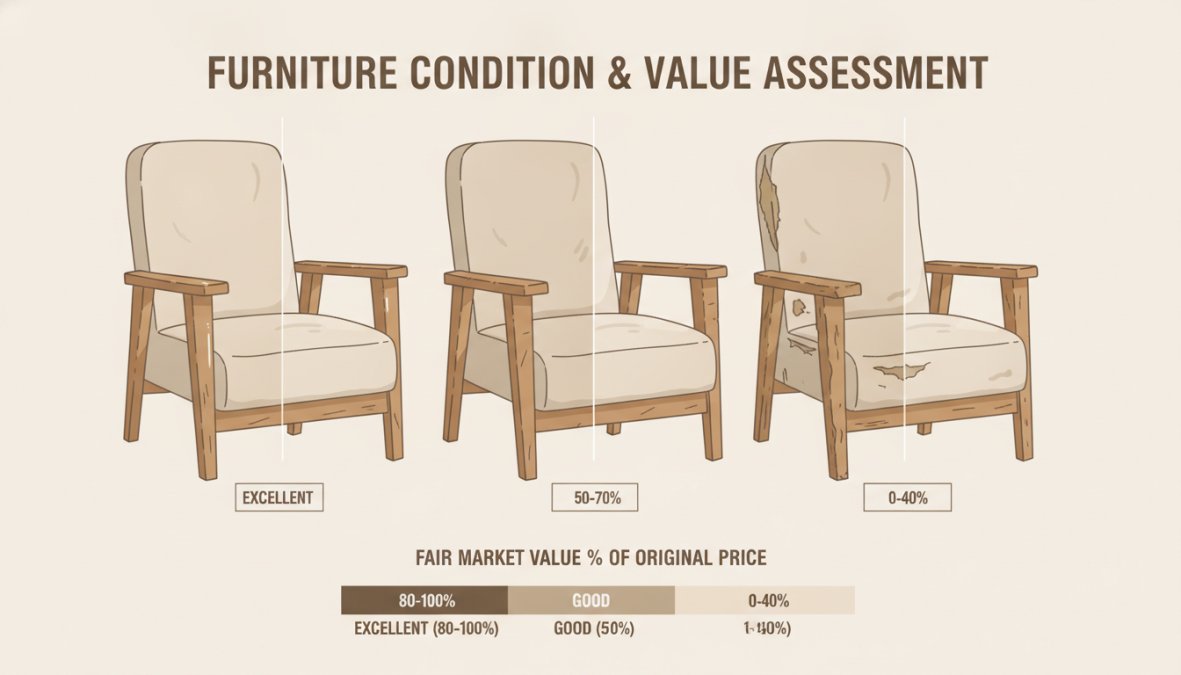
Grading Condition: Mint to Thrift Value
Most consignment stores use a four-to-five-tier condition grading system.
Mint condition shows no visible wear, damage, or use. Upholstery is pristine, wood has no scratches, hardware functions perfectly. Mint pieces command 70-85% of original retail price.
Excellent condition shows minimal wear consistent with light use. No stains, tears, or major scratches. Excellent pieces price at 50-70% of original retail.
Good condition is clean and functional with some visible wear. Minor scratches on wood, slight fading on upholstery, small marks that don’t affect usability. This is the most common tier for consignment furniture, pricing at 30-50% of original retail.
Fair condition is usable but shows clear wear. Visible scratches, fading, minor stains that don’t affect function. Fair condition pieces price at 15-30% of original retail.
Thrift value means heavily worn pieces with significant damage or requiring repair, pricing at 5-15% of original retail.
Your grading must be honest. Overstating condition loses customer trust and results in returns. Understating condition leaves money on the table.
Assessing Upholstery, Scratches, and Wear
Upholstery condition is the single biggest factor in pricing soft furniture. Look for color fading from sunlight, pilling or fuzzing on fabric, seam separation, cushion firmness, odors from smoke or pets, and structural integrity. For wood furniture, assess finish condition, scratches and gouges, water marks, joint stability, and hardware function.
Photograph furniture from multiple angles in natural light before consigning. This documentation helps dispute condition disagreements later and gives the store clear reference images for online listings.
Consignment Commission Rates Furniture: What You Need to Know
Your take-home profit depends entirely on the commission structure. A $400 sale at 50/50 nets you $200. The same $400 sale at 40/60 nets you $160. Over multiple pieces, commission rates compound significantly.
Industry Standard Commission Structures
50/50 split: Consignor receives 50%, store receives 50%. Increasingly rare but represents fair value for both parties. Le Rouge Tete operates on this model.
60/40 split (consignor/store): Consignor receives 60%, store receives 40%. Uncommon but occasionally offered for high-value items.
40/60 split (consignor/store): Consignor receives 40%, store receives 60%. The industry standard for many mid-market consignment stores.
Tiered commission structures: Some stores offer sliding scales based on item price or category, with time-based adjustments that may drop an item from 40/60 to 50/50 after 60 days if unsold.
The 50/50 consignment split at Le Rouge Tete is significantly more favorable than the 40/60 industry standard. Your furniture only needs to sell for 80% of what it would at a traditional consignment store to net the same amount.
50/50 Splits vs. Other Models
A 50/50 split incentivizes the store to price and sell your furniture well. When comparing consignment options, factor in more than just commission: foot traffic and visibility, online presence, return policy, pricing input, and payment timing. A 40/60 store with excellent foot traffic and active online marketing might move your furniture faster than a 50/50 store with poor visibility.
Researching Local Market Comps and Brand Equity
Comparable sales, or "comps," are your pricing foundation. A comp is a similar piece of furniture that recently sold in your local market at a known price. Finding three similar pieces that sold in the last 60 days tells you the current fair market value.
Using Comparable Sales to Set Prices
Identify your furniture’s key attributes: brand and designer name, style or era, materials, dimensions, condition, and original retail price. Then search for recent sales of similar pieces. Facebook Marketplace and Craigslist local listings are free starting points. Local consignment stores’ websites show asking prices. Heritage Auctions and Sotheby’s provide sold prices for higher-end furniture.
Find 3-5 comps as similar as possible to your piece. A 10-20% price range is typical. Once you have comps, adjust for condition differences. If your piece is in excellent condition and comps are in good condition, price yours 10-15% higher.
Asking price is not the same as sold price. A piece listed at $600 might sell for $450. Focus on actual sales when possible.
Designer Labels and Brand Recognition Impact
Brand equity dramatically affects resale value. A sofa by Herman Miller or Knoll commands significantly higher prices than an equivalent sofa from a mass-market brand.
High-equity brands typically hold 60-80% of original retail price in good condition. Mid-tier brands hold 40-60%. Mass-market brands hold 20-40%. Unbranded furniture holds 10-30%.
Research your brand: Is it a recognized designer name? Do pieces appear regularly in consignment stores? Are there active online communities discussing the brand?
Furniture Resale Value 2026: Factors That Drive Demand
Resale value fluctuates based on trends, seasonality, economic conditions, and category-specific factors. Understanding these dynamics helps you time your consignment and price strategically.
Seasonality Trends and Market Timing
Spring (March-May): Peak season for furniture sales. People refresh homes after winter, and new graduates furnish apartments. Prices are highest. Consign during late February to capture spring demand.
Summer (June-August): Still strong but cooling. Families prioritize vacations.
Fall (September-November): Moderate demand. Holiday entertaining drives dining furniture demand.
Winter (December-February): Weakest season. However, January is a secondary peak for fitness equipment and office furniture.
Pricing strategy should account for seasonality. A dining table consigned in March can price higher than the same table consigned in December.
Outdoor Furniture, Vintage, and Antique Premiums
Outdoor furniture represents a distinct market segment with seasonal but intense demand. Quality outdoor pieces, teak, wrought iron, high-end resin, command strong resale values because outdoor furniture is expensive new and durable when maintained.
Vintage furniture, pieces 20-50 years old, often commands premiums if from recognized designers or eras. Mid-century modern furniture is especially strong. For most consignors, the key insight is that furniture with provenance, designer attribution, or distinctive style holds value better than generic pieces.
Consignment Furniture Value Calculator and Digital Tools
Digital valuation tools are increasingly available, though their accuracy varies. These tools use machine learning to estimate resale value based on brand, style, condition, and comparable sales data.
How AI and Digital Valuation Tools Work
Modern valuation tools scrape data from online marketplaces, Facebook Marketplace, Craigslist, consignment store websites, and auction results. When you input furniture details, the algorithm finds similar pieces and suggests a price range.
The advantage is speed and consistency. The disadvantage is that algorithms miss context. As of 2026, several platforms offer furniture valuation: Facebook Marketplace’s price suggestions (free, built-in), specialized consignment platforms like Poshmark and Vestiaire Collective (for higher-end items), and local consignment store tools.
Use multiple valuation sources. If a tool suggests $400, a comp search suggests $380, and the consignment store suggests $350, the true fair market value is probably $360-380.
Calculating Net Profit After Fees and Logistics
Most consignors calculate what a piece will sell for but forget to subtract commission, delivery costs, and sometimes storage fees.
Estimated selling price: $400
Consignment commission (50/50): -$200
Your gross proceeds: $200
If you had to pay to deliver the furniture to the store, subtract that:
Estimated selling price: $400
Consignment commission (50/50): -$200
Delivery cost: -$50
Your net proceeds: $150
For large or heavy furniture, delivery costs matter significantly. Some consignment stores offer free or low-cost delivery. Le Rouge Tete offers convenient $50 local pickup for large items, which makes the math much better.
Consignment Furniture Contract Tips: Negotiation and Terms
The consignment agreement defines your rights, the store’s responsibilities, and what happens if things go wrong. Reading and negotiating this agreement is essential.
Key Clauses and Protection for Consignors
Commission rate: Clearly stated percentage split. Ensure this matches what you agreed verbally.
Consignment period: How long the store will hold your furniture before returning it unsold. Standard is 60-90 days.
Price setting: Who sets the price? You, the store, or negotiated together?
Condition documentation: Does the store photograph the furniture at intake? This protects you if there’s a dispute about condition later.
Payment terms: When do you get paid? Upon sale, or monthly?
Damage liability: Who’s responsible if the furniture is damaged while at the store?
Unsold item return: If the piece doesn’t sell, does the store return it to you, or can they donate/discard it?
At Le Rouge Tete, our 50/50 split and no-end-date consignment policy mean your furniture stays until it sells. Our consignment agreement is straightforward, and we encourage consignors to ask questions about any clause.
Tax Implications and Profit Tracking
Consignment income is taxable. Track everything: original purchase price, consignment selling price, commission paid, net proceeds received, delivery costs paid, and dates consigned and sold. This documentation is essential if the IRS questions your income and helps you analyze which pieces are profitable.
Pricing Strategies: Fast Sales vs. Maximum Profit
Different goals require different pricing strategies. Understanding your priority, speed or profit, shapes how you price.
Staging and Presentation to Justify Higher Prices
Presentation dramatically affects perceived value. Before consigning, invest in cleaning: professional cleaning for upholstered furniture if there are stains or odors (cost $50-150 but often justifies a $100-300 price increase), cleaning and polishing wood furniture, and polishing or replacing hardware.
Staging matters too. Consignment stores that display furniture in a "live in" layout, a sofa next to a coffee table and lamp, a desk with a chair, sell pieces faster than stores that line furniture up in rows. For online consignment or private sales, photography is everything. Multiple angles, natural lighting, close-ups of condition issues, and lifestyle shots all increase buyer confidence and justify higher prices.
| Staging Element | Impact on Price | Implementation Cost |
|---|---|---|
| Professional cleaning | +15-25% | $50-150 |
| Live-in display arrangement | +10-20% | Free (store responsibility) |
| Professional photography | +5-15% | $0-50 |
| Detailed condition description | +5-10% | Free |
| Brand/designer emphasis | +10-30% | Free |
Negotiation Tactics and Inventory Turnover
If your goal is maximum profit, price higher and be patient. If your goal is fast turnover, price lower and accept smaller margins.
Fast-sale strategy: Price 10-15% below market comps. This attracts budget-conscious buyers and moves inventory quickly.
Maximum-profit strategy: Price at or slightly above market comps, especially if the piece is in excellent condition or from a desirable brand. Accept that it might take 90-120 days to sell.
Negotiation strategy: Price slightly above where you’re willing to sell, anticipating that buyers will negotiate.
Inventory turnover affects the store’s profitability and your access to consignment space. Stores track which consignors’ furniture moves quickly. Consignors with fast turnover get better floor space and more aggressive marketing.
Pricing consignment furniture accurately requires research, honesty about condition, and strategic thinking about your goals. Most successful consignors prioritize speed early to build a track record with the store, then shift toward maximum profit once they’ve established credibility.
Pricing consignment furniture accurately requires research, honesty about condition, and strategic thinking about your goals. Le Rouge Tete’s 50/50 consignment split and no-end-date policy mean you have the luxury of pricing confidently without artificial pressure to mark down quickly. Our 16 years of community service and commitment to quality means your furniture gets displayed in a live-in layout that showcases its best qualities. With new items added weekly and convenient $50 local pickup for large items, consigning with us removes the logistics friction that makes consignment challenging elsewhere.
Ready to consign? Contact Le Rouge Tete to discuss your furniture and get a preliminary valuation. We’ll help you price strategically and connect you with buyers who appreciate quality pieces.
Frequently Asked Questions
How do you calculate consignment furniture prices in 2026?
Start by assessing the furniture's condition (mint, excellent, good, fair, or thrift value), then research comparable sales of similar pieces in your local market. Determine the original retail price if possible, and apply a percentage-based depreciation model, typically 30-60% of original retail depending on age, brand, and condition. Factor in your consignment store's commission structure (commonly 50/50 splits) and subtract shipping/logistics costs to arrive at your net profit. Digital valuation tools can help streamline this process.
What percentage do consignment stores take for furniture in 2026?
Consignment commission rates furniture vary by store and agreement type. Industry standard commission structures range from 40/60 to 50/50 splits, with the store typically taking 40-50% and the consignor receiving the remainder. Some stores offer sliding scales based on item price or inventory turnover speed. Always review your consignment agreement carefully before signing, as terms may include holding periods, pricing authority, and conditions for unsold items.
What factors influence the resale value of consignment furniture?
Key factors affecting furniture resale value 2026 include: condition grading (scratches, upholstery wear, structural integrity), brand equity and designer labels, original retail price, age and style (vintage and antique pieces often command premiums), seasonality trends (outdoor furniture peaks in spring/summer), and local market demand. High-quality construction, timeless design, and minimal damage preserve value. Staging and presentation also significantly impact buyer perception and final selling price.
Are there online calculators for consignment furniture value?
Yes, digital valuation tools and AI-powered price estimators are increasingly available to help with consignment furniture value calculator functions. These tools analyze comparable listings, condition photos, brand data, and local market trends to suggest pricing. However, they work best when combined with manual research of local comps and understanding your specific store's commission structure. Always verify calculator results against actual marketplace listings and consignment agreements in your area.
What consignment furniture contract tips should I follow before signing?
Key consignment furniture contract tips include: clarify the commission rate and payment schedule, confirm whether pricing decisions are yours or the store's, understand holding periods and what happens to unsold items, verify insurance coverage, and ensure you understand tax implications of your consignment income. Request written confirmation of item descriptions and condition notes. Review end date policies, some stores offer no end dates, allowing flexible consignment periods. Always request a copy of the signed agreement for your records.
How do shipping and logistics costs affect consignment profit margins?
Shipping and logistics costs can significantly reduce your net profit from consignment sales. Factor in packaging materials, carrier fees, insurance, and potential damage claims. For large furniture pieces, local pickup options (like Le Rouge Tete's $50 local pickup service) reduce costs compared to national shipping. Calculate these expenses before setting your consignment price to ensure realistic profit margins. Some consignors negotiate with stores to cover shipping costs or adjust commission rates accordingly.
What seasonality trends affect furniture consignment pricing in 2026?
Seasonality trends for 2026 show outdoor furniture commands higher prices spring through early fall, while indoor pieces see stronger demand in winter months when people refresh their homes. Home refresh cycles peak after holidays and before summer entertaining seasons. Vintage and antique furniture remains relatively stable year-round but may see spikes during estate sale seasons. Understanding these demand patterns helps you time consignment placements and adjust pricing strategies to align with buyer interest cycles.
This article was written using GrandRanker