
Last Updated: November 12, 2026
Quick Summary
To authenticate antique furniture, start with a non-destructive visual inspection, then check the wood, joinery, hardware, and any maker’s marks or provenance together, since no single clue is conclusive. Furniture is generally called antique at 100 years old, and high-value pieces should be reviewed by a qualified appraiser.
- Furniture is generally called antique when it is at least 100 years old.
- Look at the underside, back panels, and inside drawers, where wear is harder to fake.
- Hand-cut dovetails tend to show uneven spacing, while machine-cut dovetails are evenly spaced.
- Hand-forged nails and early slotted screws suggest older construction, while Phillips-head screws point to later manufacture.
- Ask any expert whether they provide an authentication opinion or an appraisal, and request a written report.
Table of Contents
- What Makes Furniture Antique and How Age Is Assessed
- Step 1: Start With a Non-Destructive Visual Inspection
- How to Identify Antique Wood Furniture by Species and Surface Signs
- How to Tell Age of Furniture by Dovetail and Joinery
- How to Date Furniture by Hardware, Screws, and Fasteners
- Checking Maker’s Marks, Labels, Provenance, and Ownership History
- Authentication Limits, Costs, and Choosing an Expert in Carteret County
- Booking a Furniture Review With Le Rouge Tete
- Frequently Asked Questions
What Makes Furniture Antique and How Age Is Assessed
Furniture is generally called antique when it is at least 100 years old, which is the threshold many appraisers and dealers use when they set out to authenticate antique furniture. The exact definition can vary by source and by who is asking.
Age is judged from several things at once, not from a single clue. Construction methods, wood choice, hardware style, and finish all shift over time.
Watch out: a piece can look worn on purpose. Some reproductions are distressed with sandpaper, chains, or stains to fake age, so wear alone proves nothing.
Step 1: Start With a Non-Destructive Visual Inspection
Start by looking at the piece without touching the finish or taking anything apart. Bring a good flashlight, a soft cloth, and a notepad. Work slowly, from the top down, and photograph anything you want to revisit.
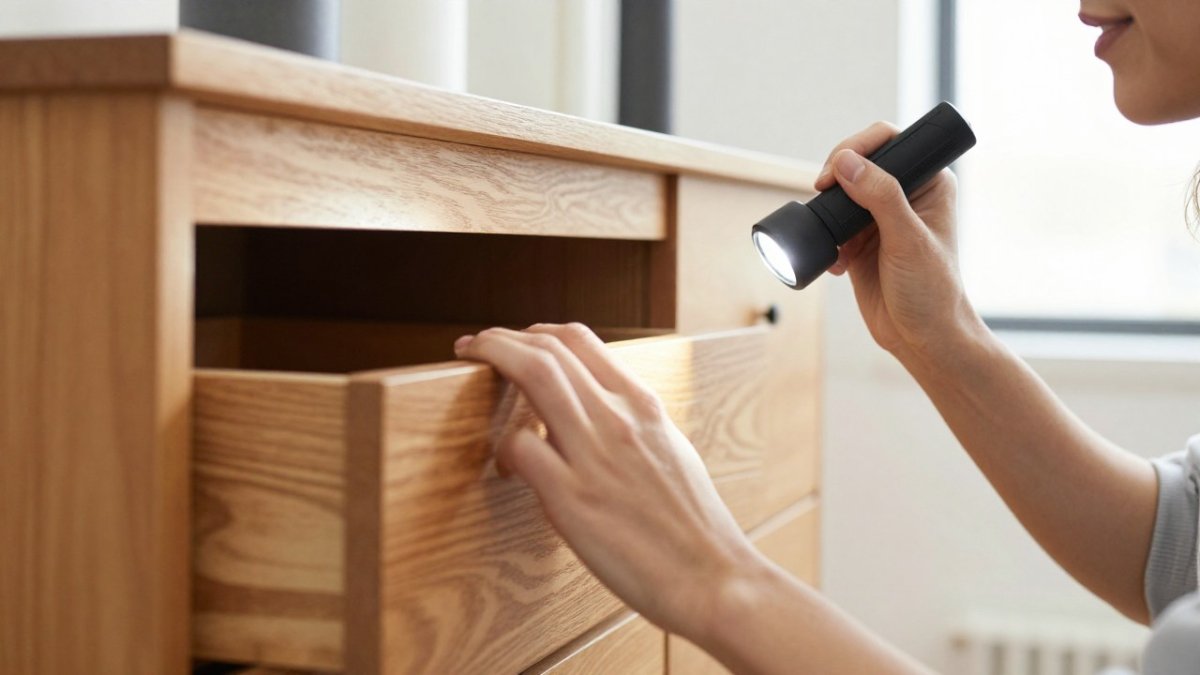
Check these areas first:
- Overall proportions and the style of legs, feet, and carvings
- The underside, back panels, and inside drawers, where wear is harder to fake
- Drawer runners, sides, and bottoms for saw marks and wood movement
- Any cracks, repairs, or loose joints
A simple walk-through helps. Pull out each drawer, look inside the cabinet, and note any mismatched parts. Keep a written record so you can compare notes later.
How to Identify Antique Wood Furniture by Species and Surface Signs
Wood species tells you a lot about where and when a piece was made. Common North American woods in older furniture include oak, walnut, cherry, mahogany, and pine. Imported tropical woods were also used in many periods. Pine was often used for the backs and drawer sides of better furniture, even when the visible surfaces were a finer wood.
Look at the surface for signs of real age:
- Uneven wear on high-touch areas like edges, drawer pulls, and table tops
- Dust and grime that settle into grain and joints over decades
- Small shrinkage cracks that follow the grain
- A finish that has darkened or softened naturally, not uniformly
A common mistake is judging wood by color alone when you authenticate antique furniture. Stains and refinishing can change how any species looks, so focus on the grain and the wood underneath where possible.
How to Tell Age of Furniture by Dovetail and Joinery
Joinery is one of the most reliable clues because it is hard to fake convincingly and expensive to alter. The goal is not to find one perfect joint but to see whether the joints, tool marks, and fasteners on a piece tell the same story.
Dovetails: read the shape, not just the spacing
A dovetail is a fan-shaped pin that locks into a matching socket. On older hand-cut work, the pins and tails are usually laid out by eye, so spacing varies from one corner to the next, the angles are slightly different, and the saw cuts may overshoot the baseline a little.
A common pattern is that earlier hand-cut dovetails are narrower and more numerous, while later production dovetails are wider and fewer because a machine cutter is set to one size. That is a tendency, not a rule, so treat it as one clue among several.
Tool marks on drawer bottoms and cabinet interiors
Turn the drawer over and look at the bottom and the inside of the sides, where finishing was often skipped:
- Hand-plane marks show as faint, slightly wavy ridges running the length of the board.
- Circular saw marks from a table saw or radial arm saw show as arcs; earlier circular-saw marks are often coarser and more pronounced.
- Straight-line rip marks from a band saw or hand saw run parallel to the edge.
- Random-orbit sander swirls are a strong sign of modern production.
Watch out: a single power-tool mark does not automatically make a piece modern, because older furniture was often repaired with whatever tools were on hand. Look for a pattern across several surfaces.
Other joints worth checking
| Joint type | Often seen in | What it suggests |
|---|---|---|
| Hand-cut dovetails, uneven spacing | Older hand-built drawers and case pieces | Earlier craftsmanship |
| Machine-cut dovetails, even spacing | Mid-20th century onward | Later production methods |
| Pegged mortise and tenon | Many older frames, chairs, and tables | Traditional assembly |
| Knapp joint (scalloped pins) | Some late 19th century American case goods | A narrow production window worth researching |
| Glued butt joints with staples or pocket screws | Lower-cost modern pieces | Usually newer |
Pegged mortise-and-tenon joints use a wooden pin driven through the tenon to lock it. On genuinely old pieces the pegs are often slightly proud, uneven in size, and darkened with age; on reproductions they are frequently uniform and flush.
Cross-check the joinery against the rest of the piece
A drawer with hand-cut dovetails but Phillips-head screws in the runners is a mixed signal. Note each clue separately, then ask whether the piece could plausibly have been built that way, or whether the drawer, top, or legs were replaced later. Repairs and replacements are common in furniture over 100 years old and do not by themselves make a piece less desirable, but they should change how you describe it and what you are willing to pay.
How to Date Furniture by Hardware, Screws, and Fasteners
Hardware is one of the quickest ways to test a piece’s age. Hand-forged nails have irregular heads and tapered shanks. Early machine-made screws have slotted heads and uneven threads.
Watch for signs of replacement. Mismatched pulls, extra screw holes, or stripped wood around fasteners can mean parts were swapped. Replacement hardware is common and does not automatically make a piece less valuable, but it should be noted.
Check that the hardware matches the style of the piece. A reproduction often uses cheap, shiny hardware with a style that does not fit the period.
Checking Maker’s Marks, Labels, Provenance, and Ownership History
Maker’s marks, labels, stamps, and signatures can be strong evidence, but they can also be added or copied. Look carefully inside drawers, under tops, and on the back. Compare any mark with reference books or databases from reputable sources before trusting it.
Provenance is the documented history of ownership. Ask the seller for receipts, appraisals, photographs, or family records. A detailed history backed by paper is more convincing than a verbal story.
Keep in mind that a missing label does not mean a piece is fake. Many fine makers never signed their work.
Authentication Limits, Costs, and Choosing an Expert in Carteret County
No checklist can guarantee authenticity. Visual and physical clues give you a confidence level, not a final verdict. High-value pieces, or any piece where a mistake would be costly, should be reviewed by a qualified appraiser or furniture expert. The practical question is not whether to hire help but what kind of help you actually need.
Authentication versus appraisal: they are not the same service
An authentication opinion answers ‘is this what it claims to be?’ An appraisal answers ‘what is it worth, and for what purpose?’ The two overlap, but they serve different needs. If you are buying, selling, insuring, donating, or settling an estate, you may need an appraisal even when you are confident the piece is genuine. If you are resolving a dispute about a maker or period, you need an authentication opinion with reasoning you can show to someone else.
Ask any expert up front which service they are providing, what it will cover, and whether the report is intended for a specific use such as insurance, tax, or resale.
What to ask before you hire anyone
- Which periods, makers, or furniture types do you work with most often?
- What is your background, and are you a member of a professional appraisal organization?
- Will you examine the piece in person, and will you look at the underside, drawer interiors, and hardware?
- What will the written report include, and will it explain the reasoning behind the conclusion?
- How is the fee structured, and will you provide a written quote before starting?
- Do you have any financial interest in the piece or in a subsequent sale?
Be cautious of anyone who offers a confident verdict from a few phone photos or who pressures you toward a sale.
What a useful report should contain
A written report is more valuable than a verbal opinion because it documents what was examined and why the conclusion was reached. Look for a description of the piece, the clues observed, the reasoning, any caveats about replaced parts or uncertain areas, and a clear statement of the confidence level. If the report gives only a verdict with no reasoning, ask for the reasoning in writing.
When an in-person specialist is necessary
Some questions cannot be settled from a checklist or a set of photos. Consider an in-person review when the piece is high value, when the maker’s mark is disputed, when the finish or hardware may have been altered, or when the difference between an original and a later reproduction changes the price significantly.
Costs and timelines
Authentication and appraisal fees vary widely by region, by the complexity of the piece, and by whether travel is involved. Ask for a written quote before you agree to any service, confirm whether the fee is flat, hourly, or based on the item’s value, and ask how long the report will take. If you are also looking for a place to sell an authenticated piece nearby, see where to sell furniture locally in Carteret County. For nearby outlets, see our list of consignment shops near Morehead City.
Booking a Furniture Review With Le Rouge Tete
At Le Rouge Tete, we help local shoppers and sellers take a closer look at pre-loved furniture before they decide. If you have a piece you want reviewed, contact us to talk through what you have and what questions you want answered. If you plan to sell after review, our safe consigning guide for antique furniture sellers explains the steps to take.
Frequently Asked Questions
Is there a free app to check antiques?
Several free apps can help you narrow down a piece, including image-search tools and marketplace price-history features, but none can authenticate furniture on their own. An app can suggest a style period or a likely maker, which gives you a starting point for research. Treat its output as a lead to verify with physical inspection, documented provenance, and, for valuable pieces, a certified appraiser. Photos taken in poor light or from a single angle often produce misleading matches, so photograph the joinery, hardware, and any marks up close before you search.
What is the 100-year rule for antiques?
Under the common 100-year rule, an object generally qualifies as an antique once it is at least 100 years old. The rule is a rough guideline rather than a legal definition, and many dealers and appraisers use it when describing items. Age alone does not make furniture valuable or authentic, since reproductions are often made in older styles. Use the 100-year benchmark as one factor alongside construction methods, materials, hardware, and documented history.
How do you know if your antique furniture is valuable?
Value depends on the maker, the period, condition, originality, and current demand. Pieces with a documented maker’s mark, original hardware, unrestored finish, and no major structural repairs usually command more. Original condition matters, so be cautious about refinishing or replacing parts before you have the piece evaluated. For a reliable market value, consult a certified appraiser, who can examine the piece in person and explain how comparable sales support the estimate.
How can you date antique furniture by its feet?
Furniture feet can offer clues about style and period. Carved ball, bun, bracket, and claw-and-ball feet are associated with particular eras, and worn feet can show long use. However, feet are often replaced, and reproductions copy popular styles, so a single feature rarely settles the question. Compare the feet with the rest of the piece, including joinery and hardware, and check whether the wear pattern on the feet matches the wear on the floor-contact areas of the frame.
