
Table of Contents
- Consignment vs Selling Furniture Online: Key Differences
- Comparison Table: Consignment Shop Commission Rates and Fees
- Best Websites to Sell Furniture Online
- Tips for Selling Furniture on Facebook Marketplace
- How to Price Used Furniture for Sale
- Profitability, Time Investment, and Effort: Consignment vs Online
- Safety, Liability, and Tax Implications
- Sustainability Impact: Consignment vs Online Resale
Consignment vs Selling Furniture Online: Complete 2026 Guide
Last Updated: July 11, 2026
When you have quality furniture to move, the choice between consignment vs selling furniture online shapes your timeline, profit margin, effort level, and final payout. Le Rouge Tete has spent over 16 years helping furniture owners navigate this decision. Understanding the real differences between these approaches separates a quick $200 sale from a weeks-long headache that nets you $50.
Consignment vs Selling Furniture Online: Key Differences
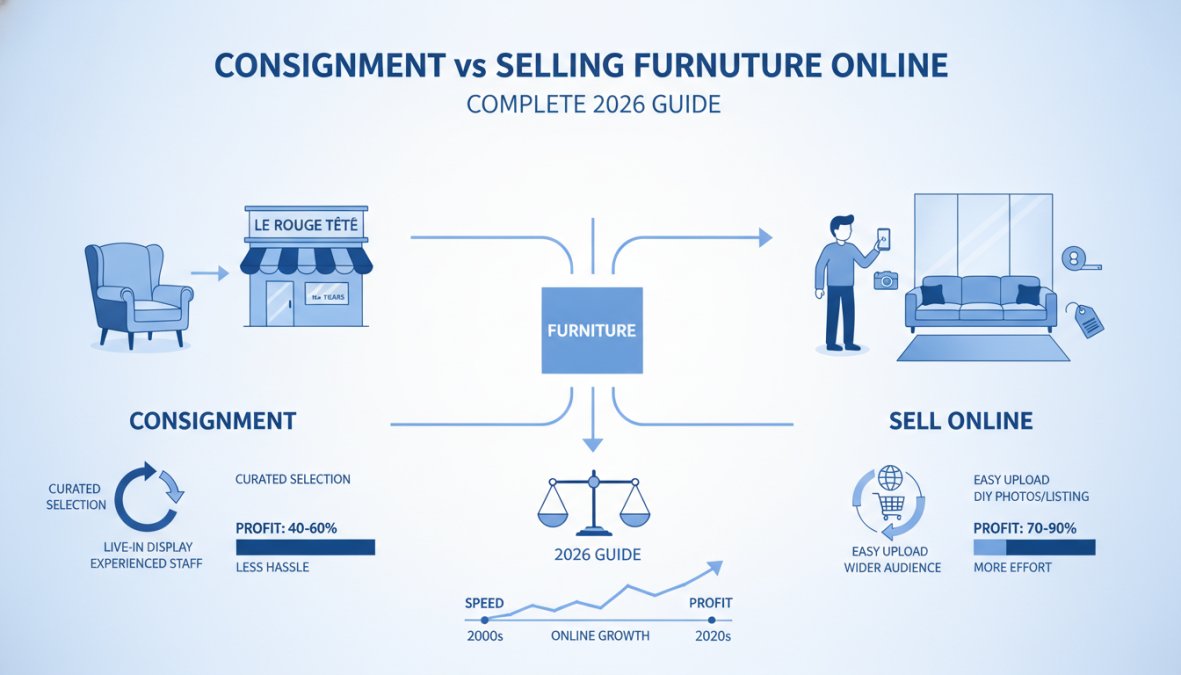
The core difference is who bears the risk and does the work. When you consign furniture, the store handles photography, display, inquiries, transactions, and payment collection. When you sell online, you own every step: photography, listing, communication, negotiation, logistics, and payment.
Consignment stores typically take 40-60% commission, leaving you 40-60% of the sale price. Facebook Marketplace charges zero fees but demands your active participation. Chairish and AptDeco fall between, charging 20-30% commission while handling some logistics.
Consignment stores have curated audiences of serious buyers actively shopping for furniture. Facebook Marketplace reaches your immediate neighbors but also attracts tire-kickers and scammers. Online platforms give you control over pricing and presentation, but that control comes with responsibility.
Timing differs dramatically. A consignment store might take 6-12 weeks to sell a piece, though some items move in days. Online sales can happen within 48 hours or drag on for months, depending on price, condition, style, and local demand.
How Consignment Stores Work
A consignment store accepts your furniture on a contractual basis, displaying it in their showroom or online marketplace. You retain ownership until the piece sells. The store handles marketing, inquiries, negotiation, and the transaction. Once sold, the store takes its commission and remits your portion, typically within 30 days.
Le Rouge Tete operates on a 50/50 split, meaning you receive 50% of the final sale price with no end date on how long your item can sit in the store. The store also offers $50 local pickup for large furniture items, removing a major friction point for sellers dealing with heavy pieces.
Consignment works best for sellers who value simplicity over maximizing profit. You’re paying for convenience; the store handles everything. It’s ideal for pieces you’re uncertain about pricing, since the store sets the retail price based on market knowledge. For furniture in good condition but not rare or designer-level, consignment eliminates weeks of active selling work.
The downside is clear: you’re leaving money on the table. A $400 sofa nets you $200 if the store takes 50% commission. You also have zero control over pricing, photography, or description.
How Online Marketplaces Work
Selling furniture online means you control the entire transaction. You photograph the piece, write the listing, set the price, field inquiries, negotiate with buyers, arrange payment, and handle delivery or pickup.
Facebook Marketplace is the simplest and most accessible. It’s free to list, charges zero commission on local cash sales, and reaches your immediate community. You message directly with buyers, arrange pickup times, and complete the transaction in person. No shipping logistics, no payment processing fees (if you take cash), no middleman.
Chairish targets interior designers, collectors, and buyers shopping for high-end vintage and designer furniture. The platform curates listings, handles professional photography, and attracts serious buyers willing to pay premium prices. Chairish takes 20-30% commission, but the higher sale price often compensates. A mid-century modern credenza might sell for $600 on Facebook Marketplace and $900 on Chairish.
AptDeco specializes in furniture resale with full-service logistics. The platform handles pickup, delivery, and payment processing. You don’t move the furniture or coordinate with buyers. AptDeco takes a commission (typically 15-25%), but eliminates the logistics burden that deters many online sellers.
Online selling demands active engagement. You’ll spend 30-60 minutes photographing and writing a quality listing. You’ll answer repetitive questions and negotiate prices. You’ll manage no-shows and payment security.
The advantage is profit potential. Sell a $400 sofa on Facebook Marketplace and you keep the full $400. The same sofa on Chairish nets you $630-$720 after commission. You also control pricing, presentation, and negotiation.
Comparison Table: Consignment Shop Commission Rates and Fees
| Method | Commission Rate | Time to Sell | Effort Required | Best For |
|---|---|---|---|---|
| Consignment (Le Rouge Tete) | 50% (you get 50%) | 6-12 weeks | Minimal | Sellers who value convenience |
| Facebook Marketplace | 0% | 2 days – 2 months | High | Fast sales, local buyers |
| Chairish | 20-30% | 3-8 weeks | Medium | Designer pieces, vintage furniture |
| AptDeco | 15-25% | 2-6 weeks | Low | Sellers wanting logistics handled |
| Craigslist | 0% | 1-4 weeks | High | Budget-conscious sellers |
Best Websites to Sell Furniture Online
Facebook Marketplace: Speed and Zero Fees
Facebook Marketplace is the fastest way to reach local buyers and the only platform where you keep 100% of the sale price. The audience is massive; anyone within your geographic radius who uses Facebook can see your listing. A reasonably priced, well-photographed sofa typically generates inquiries within hours.
The zero-fee structure is real. No listing fees, no transaction fees, no commission. If you negotiate a sale price and the buyer pays cash at pickup, every dollar is yours. This makes Marketplace ideal for sellers who have time to manage the process and want maximum profit.
You’ll receive dozens of messages from people who never follow up. Prices are negotiated downward constantly; expect offers 20-30% below asking price as standard. You’ll schedule pickups that don’t happen. Payment security requires caution; cash is safest, but digital payment through Facebook introduces processing fees.
Marketplace works best for mid-range furniture in good condition: sofas, dining tables, bedroom sets, office chairs.
Chairish: Premium Audience for Designer Pieces
Chairish is built for sellers of vintage, antique, and high-end designer furniture. The platform attracts interior designers, collectors, and affluent home decorators specifically looking for curated, unique pieces. This audience will pay more for the right item.
The trade-off is a 20-30% commission and a more selective curation process. But if your furniture passes curation, you’re reaching serious buyers who understand value. A mid-century credenza that might languish on Facebook Marketplace for months can sell on Chairish within weeks at a 40-50% higher price.
The platform handles professional photography and image editing, removing the burden of DIY photos. Chairish also manages the transaction, payment processing, and shipping logistics.
Chairish is best for sellers with designer, vintage, or antique furniture with recognized brand value or historical significance.
AptDeco: Logistics Handled for You
AptDeco specializes in furniture resale with full-service logistics. The platform handles professional pickup from your home, delivery to the buyer, and payment processing. You photograph the item, write the listing, and then step back; AptDeco manages the rest.
This eliminates the biggest friction point for online sellers: moving heavy furniture and coordinating with strangers. The commission typically ranges from 15-25%. For sellers who can’t or won’t handle logistics themselves, this is a fair trade. A $500 sofa nets you $375-$425 after commission, plus you avoid the physical and scheduling burden.
The limitation is geographic. AptDeco operates primarily in major metropolitan areas: New York, Los Angeles, San Francisco, Chicago, and Boston.
Tips for Selling Furniture on Facebook Marketplace
Pricing is the first lever. Research comparable items currently listed in your area. A sofa listed at $400 when similar sofas are $300 will sit. A sofa listed at $280 when comparable pieces are $350 will sell in days. Aim for the lower end of the market range.
Photography matters more than most sellers realize. Take photos in natural light from multiple angles, showing the entire piece and any wear or damage. Include close-ups of any damage, stains, or wear. Honesty builds trust and reduces no-shows from buyers expecting something different.
Your listing description should be factual and specific. Include dimensions, materials, brand (if known), and condition. "Good condition, minor wear on one arm" is better than "Like new." Mention if delivery is available and at what cost.
Respond quickly to inquiries and be prepared to negotiate. Confirm pickup time and payment method before the buyer arrives. Screen buyers by asking logistics questions; serious buyers ask how they’ll transport the furniture. Meet in public or in your driveway, not inside your home.
How to Price Used Furniture for Sale
Pricing used furniture requires balancing market demand, condition, age, and your urgency. Start by researching comparable items on Facebook Marketplace, Craigslist, and Chairish. If you see three similar sofas listed at $350, $400, and $450, your market range is $350-$450. Price in the middle or slightly below to encourage faster sales.
Condition is the biggest pricing factor. Excellent condition commands 50-70% of retail price. Good condition commands 30-50%. Fair condition commands 10-30%.
Brand matters. A sofa from Room & Board or West Elm retains more value than the same style from IKEA. Designer pieces (Herman Miller, Eames, Knoll) retain 40-60% of retail value. Mass-produced furniture drops to 20-30% quickly.
Age affects value differently by style. Mid-century modern and vintage pieces often appreciate or hold value. Contemporary pieces depreciate faster.
If you need the sofa gone in two weeks, price 10-15% below market. If you can wait two months, price at market and be patient.
Profitability, Time Investment, and Effort: Consignment vs Online
The financial outcome depends on your hourly rate for time invested. If you sell a $400 sofa on Facebook Marketplace, you keep $400. That sofa required approximately 2.5 hours total (photography, listing, messaging, negotiation, coordination). Your effective hourly rate is $160/hour.
The same $400 sofa consigned at Le Rouge Tete nets you $200 but required only 20 minutes total. Your effective hourly rate is $600/hour. The consignment store did 2.5 hours of work that you didn’t do.
This math flips for higher-priced items. A $1,200 designer sofa sold online nets you $1,200 for 3 hours of work ($400/hour). The same sofa consigned at 50% commission nets you $600 for 20 minutes of work ($1,800/hour).
Time to cash matters too. Consignment stores typically remit payment 30 days after sale. Online sales can be cash-in-hand at pickup. If you need money now, online selling wins.
Volume changes the equation. Selling one sofa online is fine. Selling five sofas online in a month becomes a part-time job. Consignment stores are built for volume; they can list and manage multiple pieces simultaneously.
Safety, Liability, and Tax Implications
Transaction Safety and Scam Prevention
Online furniture sales attract scammers. Common scams include fake payment confirmations, requests to ship before payment clears, and buyers who claim items arrived damaged then demand refunds.
Cash at pickup is the safest payment method. The buyer sees the furniture, you see the cash, the transaction is complete. If you accept digital payment, use platforms with buyer protection like PayPal Goods & Services or Venmo. Never accept wire transfers, gift cards, or cryptocurrency.
Screen buyers before confirming pickup. Meet in public or in your driveway, not inside your home. Take photos of the furniture before pickup and get the buyer’s name, phone number, and payment confirmation.
Consignment stores handle transaction safety for you. They verify buyer identity, process payment securely, and manage disputes. This eliminates fraud risk entirely.
Insurance and Liability Considerations
When you sell furniture online, you’re responsible for the piece until the buyer takes possession. If a buyer is injured moving the furniture, they might pursue liability claims against you. Your homeowner’s or renter’s insurance typically doesn’t cover business activities like furniture sales.
Consignment stores carry commercial liability insurance. If a buyer is injured in the store or during delivery, the store’s insurance covers it.
For online sellers, the risk is manageable if you take precautions. Meet in public spaces when possible. Let the buyer handle moving the furniture. Document the condition with photos. If you’re selling regularly, consider a small business liability policy.
Tax Implications of Furniture Sales
Furniture sales are taxable income if you’re selling items at a profit. The IRS considers this a business activity if you’re doing it regularly (more than a few pieces per year). You’re required to report the income and pay taxes on it.
Keep records of what you paid for the furniture originally and what you sold it for. For consignment sales, the store typically issues a 1099 form if you sell more than $20,000 annually.
For occasional sellers (one or two pieces per year), the tax impact is minimal. For regular sellers, proper record-keeping and professional guidance are essential.
Sustainability Impact: Consignment vs Online Resale
Both consignment and online resale extend furniture’s useful life, reducing landfill waste. A sofa that would otherwise be discarded gets a second owner.
Consignment stores create a local circular economy. Furniture moves from one household to another within the same community, reducing transportation emissions. Online resale, particularly Facebook Marketplace, also emphasizes local transactions. Most furniture sales on Marketplace are local pickup, avoiding shipping emissions.
The real sustainability win is choosing either approach over disposal. Selling, whether through consignment or online, aligns financial incentive with environmental benefit.
Choosing between consignment and online selling comes down to your priorities. If you value simplicity, certainty, and peace of mind, consignment makes sense. Le Rouge Tete’s 50/50 split, no end dates, and $50 local pickup remove the friction from selling. If you prioritize maximizing profit and have time to manage the process, online selling, particularly Facebook Marketplace, keeps more money in your pocket. For high-end designer pieces, Chairish reaches the right audience. For sellers who want logistics handled, AptDeco removes the heaviest burden. Contact Le Rouge Tete to discuss consigning your furniture and benefit from over 16 years of community expertise in matching quality pieces with buyers who appreciate them.
Frequently Asked Questions
Is it better to sell furniture on consignment or online?
It depends on your priorities. Consignment stores handle the selling process for you and provide local foot traffic, but you'll split profits and wait for sales. Online marketplaces like Facebook Marketplace offer zero fees and faster local sales, but require more effort managing inquiries and logistics. Choose consignment if you prefer a hands-off approach; choose online if you want maximum profit margin and control over pricing.
How much do consignment shops usually take from furniture sales?
Commission splits vary by store. Many consignment shops take 40-50% of the sale price, leaving you with 50-60%. Some upscale consignment stores offer 50/50 splits, while others may take up to 60%. Always review the consignment agreement before submitting items. Higher-end furniture may have different rates than budget pieces. Contact your local consignment store for their specific commission rates.
What are the best websites to sell furniture online?
Top platforms include Facebook Marketplace for free local sales with zero fees, Chairish for designer and vintage pieces with a curated audience, AptDeco for full-service logistics in major cities, and Apartment Therapy Bazaar for design-conscious buyers. Each platform has different commission structures and audience reach. Facebook Marketplace is best for speed and local pickup; Chairish works well for high-end items; AptDeco is ideal if you want shipping handled for you.
How long does it typically take to sell furniture using consignment vs online methods?
Online sales through Facebook Marketplace can happen within days or weeks due to local reach and no fees incentivizing quick action. Consignment stores may take weeks to months to sell items, depending on demand and inventory turnover. Online marketplaces like Chairish attract serious buyers but may take longer for niche or expensive pieces. Consignment timelines depend on store traffic and item desirability. For urgent sales, online direct-to-buyer methods are faster.
What are the tax implications when selling used furniture?
In most cases, selling personal used furniture is not taxable income if you sell at a loss or break-even. However, if you consistently sell furniture for profit, especially as a business, you may owe income tax on gains. Keep records of original purchase prices and sale prices. Consignment income may be reported differently than direct sales. Consult a tax professional if you're selling frequently or for significant profits to understand your local tax obligations.
This article was written using GrandRanker