
Table of Contents
- Secondhand Furniture Quality: The Real Answer
- Solid Wood vs. Particle Board: Identifying Quality Construction
- How to Spot Quality Secondhand Furniture Before You Buy
- Health and Safety Risks: Bed Bugs, Mold, and Off-Gassing
- How to Clean and Sanitize Used Furniture
- Pros and Cons of Buying Secondhand Furniture
- Resale Value and Long-Term Durability
- Conclusion
Last Updated: August 25, 2026
Secondhand Furniture Quality: The Real Answer
Is secondhand furniture better quality than new pieces? The answer isn’t simple. Some vintage and pre-owned furniture outperforms modern alternatives in durability and craftsmanship, while other secondhand items carry hidden risks, bed bugs, structural damage, chemical off-gassing, that make them poor values despite lower prices.
The real question is whether you know how to identify which pieces are worth buying and which will disappoint you. At Le Rouge Tete, we’ve spent over 16 years helping homeowners navigate this decision, curating pre-loved furniture that meets rigorous quality standards while offering significant savings compared to retail prices.
This guide walks you through how to evaluate secondhand furniture, spot construction quality, assess health and safety risks, and determine when buying used actually saves you money.
Solid Wood vs. Particle Board: Identifying Quality Construction
The difference between solid wood and particle board defines whether a secondhand piece will last decades or fail in five years.
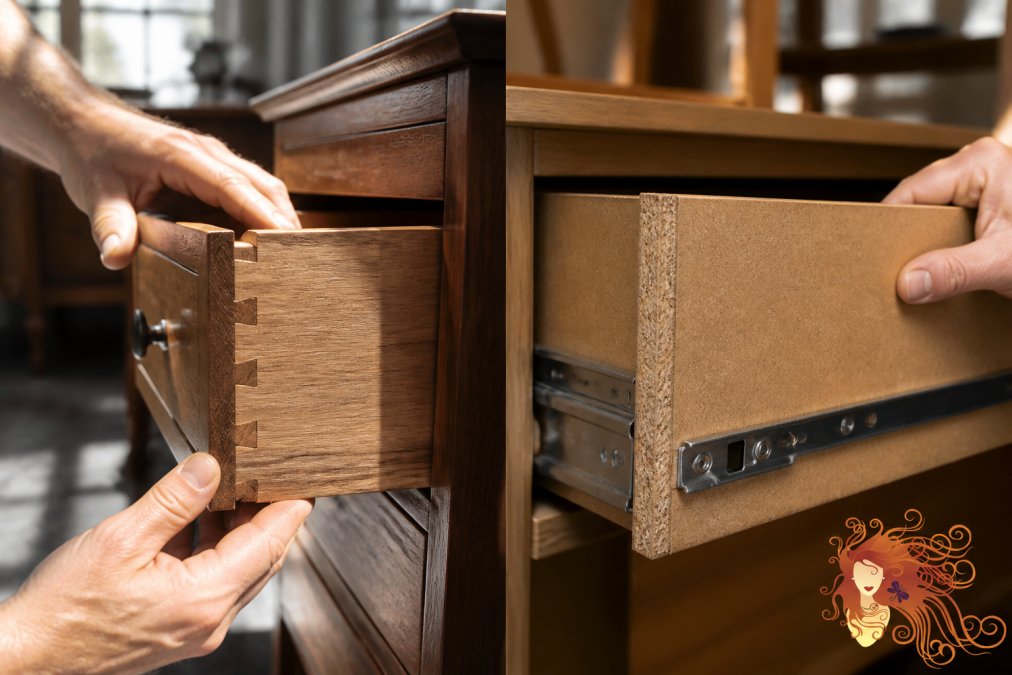
Solid wood consists of actual wood throughout the structure, drawers, frame, legs, and backing. It’s heavier, more expensive, and built to last. Particle board is compressed wood fibers mixed with adhesive, then veneered with a thin wood-grain layer. It’s lightweight, cheaper, and prone to swelling and warping when exposed to moisture.
Start with weight. Lift a drawer or the furniture itself. Solid wood feels substantial; particle board feels hollow and light. Look at edges and undersides. Solid wood shows actual wood grain and natural color variations. Particle board edges reveal compressed fiber structure, a grainy tan-colored interior under the veneer.
Check the joinery. High-quality pieces use dovetail joints, where interlocking wood pieces slot together, a hallmark of craftsmanship suggesting durability. Particle board furniture relies on dowels, screws, or metal brackets, which fail more easily. Press on corners and joints. Solid wood joints should feel rock-solid; particle board connections often flex or creak.
Examine the veneer on any piece claiming "wood construction." Run your fingers along edges where veneer meets frame. If the veneer is peeling, chipped, or separating, the furniture has absorbed moisture and is deteriorating. Look at the back panel. Solid wood furniture typically has a solid or plywood backing. Cheap particle board pieces often have thin, flimsy cardboard or particle board backs that flex easily, a red flag for structural integrity.
Ask about the wood species if possible. Hardwoods like oak, walnut, cherry, and maple are denser and more durable than softwoods like pine. Mid-century modern pieces often used quality hardwoods, which is why vintage furniture from that era commands higher prices and holds value better.
How to Spot Quality Secondhand Furniture Before You Buy
Evaluating secondhand furniture requires a systematic approach. You’re assessing structural integrity, material quality, and whether the piece will function properly in your home.
Structural Integrity Inspection
Perform a physical inspection that goes beyond appearance. Sit on chairs and sofas. Does the frame flex excessively, or feel stable? Flex indicates failing joints or weakened wood. Bounce gently; a quality piece should absorb movement without creaking or shifting.
Open every drawer. They should glide smoothly without sticking or binding. Drawers that stick suggest swelling from moisture exposure or misaligned joinery.
Check table and chair legs. Get underneath and inspect joints where legs meet the frame. Look for cracks radiating from the joint, a sign of stress and potential failure. Wiggle each leg. Excessive movement means the joinery is compromised.
For upholstered furniture, press firmly on all seating surfaces to feel for broken springs or foam deterioration underneath. Sagging that doesn’t bounce back suggests structural failure. Check the underside of cushions and frame for stains, discoloration, or moisture damage.
Inspect all hardware, hinges, handles, locks, and knobs. Tarnished or corroded hardware suggests age but is replaceable. Broken or missing hardware is a repair cost to factor in.
Upholstery and Fabric Assessment
Examine fabric closely under good lighting. Look for stains, discoloration, fading, or worn areas. Small stains may clean out; large stains suggest the piece needs reupholstering, a significant expense.
Feel the fabric. Does it feel brittle, stiff, or excessively worn? Aged fabric loses elasticity and tears easily. If the upholstery is worn but the frame is solid, factor in reupholstering costs.
Check seams carefully. Are they intact and tight, or separating? Separated seams indicate heavy use or fabric deterioration. Inspect piping and trim for fraying or deterioration.
Smell the furniture carefully. A musty odor suggests moisture exposure, possible mold, or mildew, a serious concern because mold spores can affect indoor air quality and trigger allergies or respiratory issues. Don’t ignore this warning sign.
Hardware and Drawer Slides
Quality drawer slides are a sign of well-made furniture. Inspect how smoothly drawers open and close. Metal slides should glide without resistance. Wooden slides should move smoothly without binding.
Check the drawer box itself. Solid wood drawers hold up better long-term than particle board. Look at the bottom. Solid wood bottoms are preferable to thin plywood or particle board, which sag and fail under weight.
For cabinets and storage pieces, inspect hinges. Quality hinges are solid metal and move smoothly without wobbling. Test door alignment. Doors should close smoothly without binding or sagging. Check all locks and latches for proper function.
Health and Safety Risks: Bed Bugs, Mold, and Off-Gassing
Secondhand furniture carries health risks that new furniture doesn’t.
Bed bugs hide in seams, crevices, and upholstered surfaces. They’re difficult to detect visually and can infest your home if brought inside untreated. Inspect seams and crevices closely. Look for small dark spots (fecal matter), shed exoskeletons, or the bugs themselves. If you suspect bed bugs, don’t bring the piece home. The cost of treating a home infestation far exceeds the savings from buying used.
Mold and mildew develop in furniture stored in damp conditions. Beyond the musty smell, mold spores can trigger allergic reactions, asthma symptoms, and respiratory issues. If you detect mold, avoid the piece.
Chemical off-gassing is less visible but important. Older furniture may contain formaldehyde in adhesives, flame retardants in upholstery, or other chemicals that off-gas into your home. This is particularly concerning with particle board furniture, which uses adhesives that release volatile organic compounds (VOCs) (the EPA). Airing out furniture outdoors for several days or weeks reduces off-gassing. Many vintage pieces predate modern safety standards and may contain asbestos or banned flame retardants. If buying mid-century modern or antique pieces, research the era and materials.
How to Clean and Sanitize Used Furniture
Once you’ve purchased secondhand furniture, proper cleaning and sanitization protect your home and extend the piece’s life.
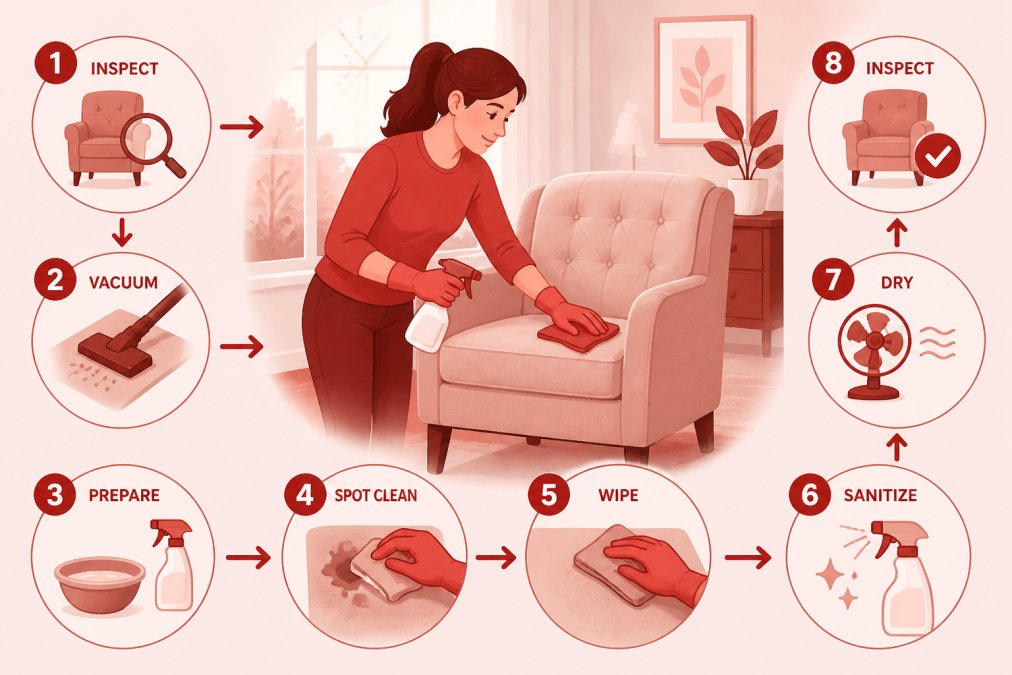
For upholstered furniture, start with a thorough vacuum using an upholstery attachment, getting into seams and under cushions. Follow with a fabric-safe cleaner, testing on a hidden area first. For bed bug prevention, if there’s any doubt about the piece’s history, heat treatment is the most effective approach (the CDC). Many dry cleaners offer furniture heat treatment services, which kills bed bugs at all life stages.
Wooden furniture benefits from gentle cleaning with a damp cloth and mild soap. Avoid excessive water, which damages wood and finishes. For leather furniture, use a leather-specific cleaner and conditioner to restore flexibility and appearance.
Address musty odors by airing furniture outdoors in sunlight for several days. If odor persists, place activated charcoal or baking soda nearby overnight to absorb odors. For particle board furniture, use minimal water and dry immediately, focusing on dusting and spot-cleaning.
Allow adequate time for off-gassing. Keep furniture in a well-ventilated space for one to two weeks after bringing it home (the EPA). Open windows, use fans, and avoid placing it in bedrooms or nurseries immediately.
Pros and Cons of Buying Secondhand Furniture
The Advantages
Cost savings are the most obvious benefit. Secondhand furniture typically costs less than comparable new pieces, making it possible to furnish a home with quality pieces on a limited budget.
Unique and curated pieces are easier to find in the secondhand market. Rather than choosing from mass-produced options, you can discover vintage, designer, or one-of-a-kind pieces that reflect your personal style.
Quality construction is often superior in older furniture. Pieces from the 1960s-1980s were frequently built with solid wood, quality joinery, and durability standards that have declined in modern fast furniture.
Sustainability matters to many homeowners. Buying secondhand extends furniture life, reducing demand for new production and associated manufacturing waste, shipping emissions, and resource consumption.
Immediate availability is another advantage. You can take a piece home today rather than waiting weeks for delivery.
The Drawbacks
Health and safety risks require careful evaluation. Bed bugs, mold, and chemical off-gassing are real concerns that demand thorough inspection and sometimes professional treatment.
Structural and cosmetic damage may be hidden. Repair costs, reupholstering, refinishing, or structural repairs, can be substantial.
Limited warranty or recourse is significant. Most secondhand purchases are final sales. Buying from a reputable consignment store like Le Rouge Tete, which inspects and stands behind its inventory, reduces this risk compared to private sales.
Time investment in shopping is substantial. Finding the right pieces requires visiting multiple locations and inspecting thoroughly.
Delivery and logistics can be challenging. Large pieces require transportation, which may cost extra. Le Rouge Tete offers convenient local pickup services, addressing this pain point.
Inconsistent quality and availability means you can’t always find exactly what you need. Inventory changes constantly.
Resale Value and Long-Term Durability
Understanding resale value and durability helps you evaluate whether a secondhand purchase is truly a good investment.
Solid wood furniture holds value better than particle board. A quality wooden dresser or dining table purchased secondhand retains value if resold later. Particle board furniture depreciates more rapidly.
Vintage and designer pieces appreciate or maintain value better than generic contemporary furniture. Mid-century modern pieces are sought-after and often sell for close to or above what previous owners paid.
Durability directly impacts long-term value. A piece lasting 15-20 years provides better value than one failing in five years. The cost per year of ownership matters most.
Condition matters significantly for resale. A well-maintained secondhand piece in excellent condition resells more easily than one showing heavy wear.
Brand and designer names affect resale value. Furniture from recognized designers or high-end brands sells more readily than generic pieces.
| Factor | High Resale Value | Low Resale Value |
|---|---|---|
| Material | Solid wood, quality upholstery | Particle board, worn fabric |
| Condition | Minimal wear, clean, functional | Heavy wear, stains, damage |
| Style | Vintage, designer, timeless | Trendy, dated, generic |
| Brand | Recognized designer or maker | Unknown or fast furniture brand |
| Age | Mid-century or antique | Recently manufactured, worn |
Is secondhand furniture better quality? The honest answer is: it depends entirely on which pieces you’re evaluating and how thoroughly you inspect them. Some secondhand furniture, particularly vintage solid wood pieces, outperforms new alternatives in durability and craftsmanship. Other secondhand items carry hidden risks or structural problems that make them poor values despite lower prices.
The key is knowing how to identify quality construction, assess health and safety risks, and distinguish between pieces worth buying and those to avoid. Le Rouge Tete’s curated selection and 16 years of community service mean every piece has been evaluated for quality and condition. Our ‘live in’ store layout lets you visualize pieces in realistic settings before committing, and our convenient local pickup services eliminate transportation hassles. Whether you’re shopping for your own home or furnishing a rental property, starting with pre-vetted secondhand furniture reduces risk and increases the likelihood you’ll find pieces that deliver real value.
Frequently Asked Questions
Q: Is secondhand furniture better quality than new furniture?
A: Quality depends on the specific piece, not whether it's new or used. Older secondhand furniture often features solid wood construction and superior craftsmanship compared to modern fast furniture made with particle board and veneer. However, not all used pieces are high-quality, and not all new furniture is poor-quality. The key is inspecting structural integrity, materials, and wear patterns. Vintage and well-maintained secondhand pieces often outlast cheaper new alternatives by decades.
Q: How do I tell the difference between solid wood and particle board in secondhand furniture?
A: Solid wood feels heavier and has visible wood grain patterns that run continuously. Particle board is lighter and has a uniform, pressed appearance. Check the underside, back panels, and drawer bottoms, solid wood shows natural wood characteristics, while particle board looks like compressed sawdust. Solid wood furniture typically lasts longer and can be refinished, making it better for long-term investment.
Q: What are the biggest health risks when buying upholstered secondhand furniture?
A: Bed bugs are the primary concern with upholstered pieces. Inspect seams, piping, and fabric folds carefully under good lighting. Mold spores can develop in damp conditions, causing musty odors and potential respiratory issues. Off-gassing from adhesives and treatments may occur in older pieces. Always request inspection photos, ask about the furniture's storage conditions, and plan to clean and sanitize thoroughly before bringing items into your home. Solid wood furniture carries fewer health risks than upholstered items.
Q: Which types of secondhand furniture are safest to buy?
A: Solid wood tables, chairs, dressers, and cabinetry are safest because they resist pest infestation and mold better than upholstered pieces. Metal-frame furniture is also low-risk. Avoid upholstered sofas and mattresses unless you can inspect them thoroughly in person. Wooden bed frames and nightstands are good choices. Always prioritize pieces with good structural integrity and no signs of water damage, pest activity, or excessive wear.
Q: Does older secondhand furniture hold its value better than modern pieces?
A: Yes, vintage and well-made secondhand furniture often maintains resale value better than mass-produced modern items. Solid wood pieces with good craftsmanship appreciate or hold value, especially if they're from recognized brands or periods. Fast furniture, cheap new items made with particle board, depreciates rapidly and has little resale value. Quality secondhand furniture can be resold for a reasonable percentage of its original price, making it a more sustainable and economical choice long-term.
This article was written using GrandRanker