
Table of Contents
- Why Pre-Loved Decor Matters More Than Ever
- Environmental Impact: Reducing Landfill Waste and Your Carbon Footprint
- How to Evaluate Used Furniture Quality Before You Buy
- Tips for Cleaning Pre-Loved Furniture and Restoring Its Appeal
- Affordable Home Decor Without Sacrificing Style or Quality
- Finding Unique Character and Investment Value in Vintage Pieces
- The Consignment Advantage: Quality Curation and Peace of Mind
- Conclusion
Last Updated: August 17, 2026
Why Pre-Loved Decor Matters More Than Ever
Buying pre-loved furniture and home accessories affects your wallet, your home’s aesthetic, and the environment simultaneously. At Le Rouge Tete, we’ve spent over 16 years helping homeowners discover that pre-loved decor often outperforms new retail alternatives. The pieces that come through consignment have already proven their durability, they’ve been lived with, tested, and selected by previous owners who cared enough to keep them.
The shift toward pre-loved furniture reflects a broader recognition: the fast furniture model doesn’t work anymore. Pre-loved pieces carry history, patina, and authenticity that new items struggle to replicate, no matter the price tag.
Environmental Impact: Reducing Landfill Waste and Your Carbon Footprint
Every piece of furniture that stays out of the landfill represents real environmental progress. When you buy pre-loved decor, you’re directly reducing the demand for new production, which means fewer resources extracted, less energy consumed, and fewer emissions generated across manufacturing and shipping.
A vintage dresser that finds a new home instead of ending up in a waste facility has already completed its environmental calculation. The carbon footprint was incurred when it was first made, decades ago. Buying it secondhand means you’re spreading that original environmental cost across multiple owners and decades of use, dramatically lowering the per-year impact.
New furniture comes with hidden costs: manufacturing produces VOC emissions affecting indoor air quality, international shipping generates substantial carbon emissions, and packaging materials end up in recycling streams or landfills. Pre-loved decor eliminates most of these new production impacts.
Upcycling and repurposing pre-loved pieces creates additional environmental benefits. A wooden table that gets refinished avoids becoming waste. Fabric items that get reupholstered extend their material lifespan. These restoration practices keep materials in circulation rather than cycling them through disposal systems.
How to Evaluate Used Furniture Quality Before You Buy
The biggest concern people have about pre-loved decor is condition. Quality used furniture doesn’t require perfect appearance, it requires honest construction and structural integrity.
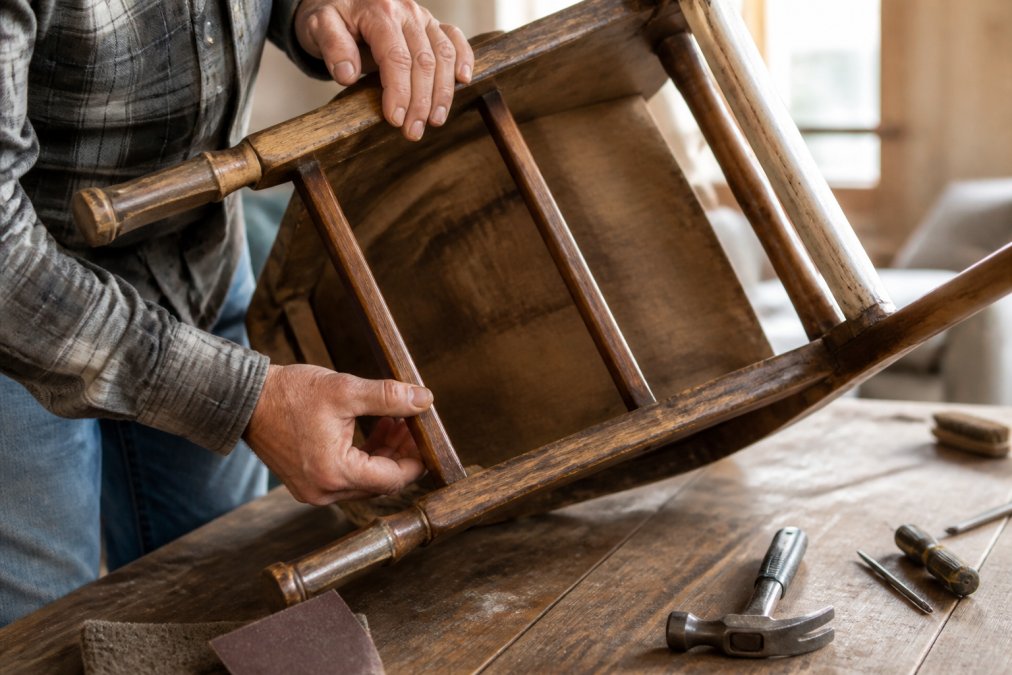
Start by understanding the difference between wear and damage. Wear is cosmetic, surface scratches, fading, minor scuffs. Damage is structural, loose joints, broken frames, compromised integrity. Wear tells you a piece has been loved and used. Damage tells you a piece may not last much longer.
Inspecting Solid Wood Construction and Material Longevity
Solid wood furniture is the gold standard for longevity. Run your hand across the surface and underneath, solid wood feels substantial and consistent. Veneer over particleboard feels hollow or flexible by comparison. Press gently on corners and joints; solid wood construction won’t flex or creak under moderate pressure.
Check the underside of tables, chairs, and dressers. Dovetail joints (interlocking wooden fingers) indicate quality craftsmanship and durability. Look for solid wood legs and frames; hollow legs or thin veneered surfaces indicate cheaper construction. Run your fingers along edges, solid wood has consistent thickness, while particleboard edges are often banded with thin veneer that peels or chips easily.
Hardwoods like oak, walnut, and cherry are denser and more resistant to denting and scratching. Softwoods like pine are more prone to damage but still serviceable if construction is solid. Avoid pieces where the wood feels soft or spongy, indicating rot or water damage.
Checking for Hidden Damage and Indoor Air Quality Concerns
Water damage and moisture problems are serious red flags. Smell the piece first, musty or moldy odors indicate moisture issues that will persist. Look for warping, swelling, or discoloration on surfaces and edges. Press on wood that appears stained; if it feels soft or spongy, the damage goes deeper than surface treatment can fix.
Inspect joints for separation. If drawers don’t slide smoothly or doors don’t close properly, the frame may have shifted due to moisture or structural failure.
Upholstered furniture requires careful inspection. Check seams for tears or separation. Press the cushions, they should feel firm and return to shape. Smell the fabric and underneath; any musty or unpleasant odor suggests the piece has absorbed odors that cleaning won’t fully remove.
Look for signs of pest damage: small holes, sawdust, or tunneling in wood. Small surface damage might be cosmetic, but extensive tunneling suggests structural compromise.
Tips for Cleaning Pre-Loved Furniture and Restoring Its Appeal
Restoration doesn’t require professional expertise for most pieces. The goal is simple: clean thoroughly, address obvious damage, and refresh the appearance without overworking it. The patina and character are part of the appeal.
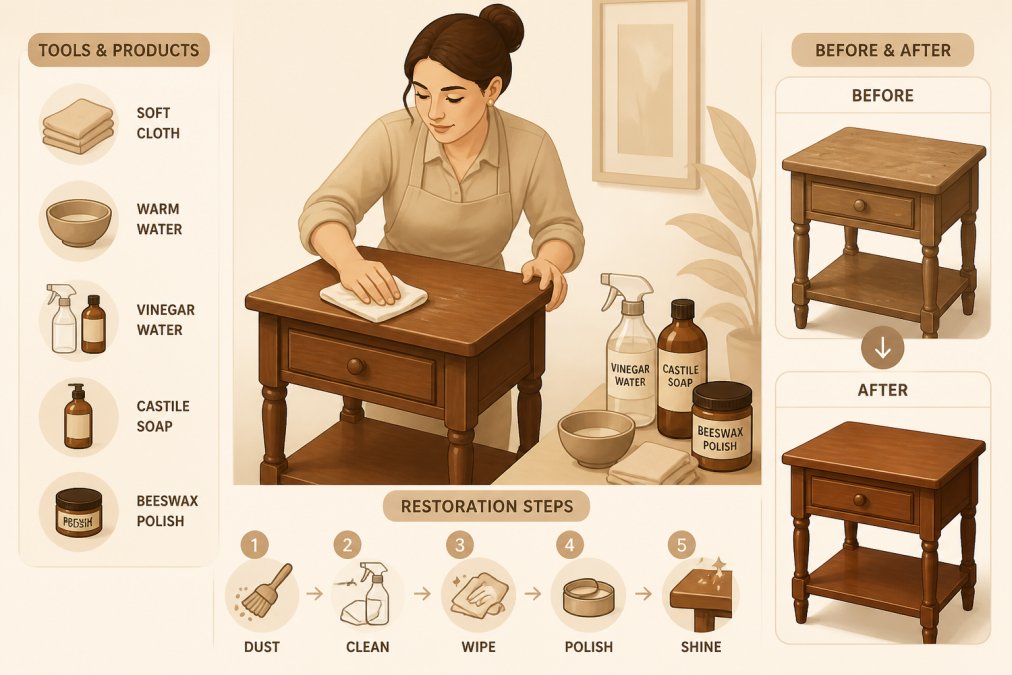
Start with basic cleaning. Dust with a soft cloth. For wood, use a barely damp microfiber cloth; excessive water damages finishes. For stubborn grime, a mild soap solution works on most surfaces. Test any cleaner on an inconspicuous area first.
For wood furniture, vinegar and water (equal parts) cuts through buildup without harsh chemicals. Dry immediately with a soft cloth. Olive oil or furniture polish brings back luster to dull finishes. Apply sparingly and buff thoroughly.
Upholstered pieces benefit from vacuuming with an upholstery attachment. For stains, cold water and mild detergent work better than heat, which can set stains permanently. Blot rather than rub. For odors, baking soda sprinkled on fabric and left for several hours absorbs smells naturally.
Minor scratches on wood respond to touch-up markers or stain pens that match the wood color. Hardware, drawer pulls, hinges, handles, often responds well to cleaning or replacement. Tarnished brass or corroded metal can be polished or swapped for new hardware that updates the look instantly.
Reupholstering transforms a structurally sound piece that’s worn cosmetically. Professional reupholstering costs vary based on complexity, but it extends the life of quality furniture significantly.
Affordable Home Decor Without Sacrificing Style or Quality
The math on pre-loved decor is straightforward: you get better construction at lower prices. New retail furniture carries substantial overhead. A sofa that costs $2,000 new might have $600-800 in actual material and labor costs. The rest covers retail space, sales staff, advertising, and profit margins. A similar pre-loved sofa still represents excellent value because the original markup has already been absorbed.
Quality construction costs the same whether a piece is new or pre-loved. A vintage chair built decades ago with quality materials is objectively more durable than a new mass-produced equivalent. The pre-loved version costs less because it’s used, not because it’s inferior.
This affordability advantage compounds when furnishing multiple rooms. A living room set from pre-loved sources can cost a fraction of new retail pricing while offering superior construction and unique character.
Le Rouge Tete’s curated selection means pieces have been evaluated for quality and condition before reaching the sales floor. Pricing reflects the actual value of the piece, not arbitrary retail markups. The ‘live in’ store layout lets you visualize items in realistic settings, reducing the risk of purchasing something that doesn’t work in your space.
The affordability advantage extends to experimentation. You can try design directions with pre-loved pieces at lower financial risk. If a style doesn’t work, you’ve invested less and can pivot without significant loss.
Finding Unique Character and Investment Value in Vintage Pieces
Pre-loved decor offers something new furniture simply cannot: authenticity and uniqueness. Mass production creates uniformity. Vintage and pre-loved pieces are inherently one-of-a-kind or part of limited runs that stopped production years ago.
This uniqueness translates directly to visual impact. A room furnished with pre-loved pieces has curated character that new retail furniture struggles to achieve. Each item has history, craftsmanship details, and design authenticity that contemporary mass production rarely matches.
Investment value is an overlooked benefit of pre-loved decor. Quality vintage and antique pieces appreciate over time. Mid-century modern furniture, for example, has become increasingly valuable as design history has recognized its significance. A credenza purchased as pre-loved decor 10 years ago might now be worth substantially more.
Quality construction, classic design, and authentic materials create pieces that hold value and don’t depreciate the way new furniture does. A well-maintained vintage table or dresser can be sold or passed down with minimal value loss, sometimes with value gain.
The heirloom quality of pre-loved furniture is real. Pieces built 40, 50, or 60 years ago with solid wood and traditional joinery will outlast contemporary furniture by decades. A piece that lasts 100 years costs less per year of use than something lasting 10 years, regardless of purchase price.
The Consignment Advantage: Quality Curation and Peace of Mind
Consignment stores like Le Rouge Tete apply quality filters that general secondhand markets don’t. Every piece is evaluated for condition, construction, and suitability before reaching the sales floor. This curation removes the guesswork and risk that comes with buying from private sellers or online marketplaces.
When you buy from an individual on Facebook Marketplace or Craigslist, you’re assessing condition yourself with limited recourse if something isn’t as described. Consignment stores have reputational incentive to ensure quality. Over 16 years of community service, Le Rouge Tete has built trust by consistently delivering pieces that meet customer expectations.
The ‘live in’ store layout lets you understand scale, proportion, and aesthetic impact before committing. You can walk around pieces, sit on them, open drawers, and visualize them in your home. This eliminates a major source of buyer regret.
Consignment also solves a practical problem: moving and logistics. Le Rouge Tete offers convenient local pickup services for large items, removing the burden of arranging transportation.
The 50/50 consignment split for sellers and no end dates on consignments create a fair, transparent process. New items added weekly keep inventory fresh and prevent the feeling of shopping through the same pieces repeatedly.
The benefits of buying pre-loved decor compound over time. Environmental impact multiplies with each purchase decision. Affordability accumulates across multiple rooms and pieces. Unique character builds into a genuinely personal home. Quality construction proves itself through years of reliable use.
Le Rouge Tete makes this decision easy by removing friction from the pre-loved furniture shopping experience. The curated selection, fair pricing, convenient logistics, and transparent consignment process mean you get quality pieces without the guesswork or regret.
Contact Le Rouge Tete to explore the curated selection of pre-loved furniture and home decor, or to discuss consigning your own pieces. Discover how quality construction, unique character, and sustainable design choices create homes that are both beautiful and responsibly furnished.
| Benefit | Impact | Best For |
|---|---|---|
| Environmental sustainability | Reduces landfill waste and manufacturing emissions | Eco-conscious homeowners |
| Affordability | Lower costs than retail for similar quality | Budget-conscious decorating |
| Unique character | One-of-a-kind pieces with authentic design history | Design-forward homes |
| Quality construction | Solid wood and traditional joinery last decades | Long-term value seekers |
| Investment potential | Quality vintage pieces hold or appreciate in value | Collectors and design enthusiasts |
| Curation and assurance | Pre-vetted pieces reduce buyer risk | First-time pre-loved shoppers |
According to EPA waste management data, furniture represents a significant portion of landfill waste annually, with most pieces discarded after just a few years of use. Pre-loved decor directly addresses this by extending product lifecycles and reducing disposal pressure.
The circular economy model for furniture is gaining recognition across sustainability research from Harvard Business Review, which documents how secondhand markets reduce resource extraction and manufacturing emissions compared to new production cycles.
For homeowners concerned about indoor air quality, EPA guidance on VOC emissions notes that older, well-used furniture has already off-gassed most volatile compounds, making it a safer choice than newly manufactured pieces with fresh chemical emissions.
Frequently Asked Questions
What are the main environmental benefits of buying pre-loved decor?
Purchasing pre-loved decor keeps furniture out of landfills, reduces demand for new manufacturing, and lowers the carbon footprint associated with shipping and production. The circular economy model extends the life of quality pieces that might otherwise become waste. By choosing secondhand items, you're actively participating in waste reduction and supporting sustainability without sacrificing style or quality.
How do I know if pre-loved furniture is actually in good condition before buying?
Inspect the frame for solid wood construction, check joints for wobbling or separation, and examine upholstery for stains or odors. Look underneath and inside drawers for signs of damage. Reputable consignment stores like Le Rouge Tete curate their inventory and inspect items before displaying them, giving you confidence in quality. Ask staff about the furniture's history and condition, professional consignment stores stand behind their pieces.
How can I safely clean and restore pre-loved furniture?
Start with gentle methods: dust with a soft cloth, use mild soap and water for wood surfaces, and test any cleaning products in a hidden area first. For upholstered pieces, vacuum thoroughly and spot-clean with appropriate fabric cleaners. Avoid harsh chemicals that may damage finishes or release VOC emissions. For pieces with patina or distressing, gentle cleaning often reveals the original character without over-restoration. When in doubt, consult professional restoration services.
Can buying pre-loved furniture actually save me money compared to retail?
Yes. Pre-loved decor typically costs significantly less than new retail furniture while offering heirloom-quality construction and unique character. You can furnish an entire room or home on a budget that would only cover a few new pieces. Consignment stores offer curated selections at reduced prices, and many pieces appreciate in value if they're vintage or antique, making them potential investments rather than depreciating purchases.
This article was written using GrandRanker