
Last Updated: November 9, 2026
Quick Summary
To move a piano without damage, measure every doorway and stairwell, clear and protect the route, then wrap the piano in blankets with corner protection and strap it to a furniture dolly. Keep it upright against the truck wall, strap it in at least two directions, and use a ramp rather than lifting it.
- Measure every doorway, hallway corner, and stairwell, then add a few inches for blankets and straps.
- Tape the keyboard lid shut, pad and tape the pedals, and bag any detachable parts.
- Tape blankets to themselves, never to the piano, since painter’s tape can pull clear coat.
- Use at least two strong people for an upright piano, and three is better on stairs.
- Stop after the first few miles and re-tension every strap before continuing the drive.
Table of Contents
- Preparation and Planning Before You Move a Piano
- How to Move an Upright Piano: Step-by-Step
- Piano Dolly Rental vs. Buying: What Makes the Lift Safer
- Protecting Piano Finish During Transit
- Lifting Technique, Weight Distribution, and Back Injury Prevention
- Loading, Strapping, and Securing the Piano for the Drive
- Hiring Professional Piano Movers in Carteret County
- After the Move: Tuning, Humidity Control, and Insurance
- Frequently Asked Questions
Preparation and Planning Before You Move a Piano
Moving a piano is the hardest furniture job in most homes. A piano is heavy, top-heavy, and easy to scratch, and one bad turn on a staircase can cost more than the move itself. Planning beats muscle every time. Below, we walk through how to move a piano without damage, step by step.
The work starts before you touch the instrument. Measure first, clear the route, and decide who lifts what. Pianos rarely get damaged on the truck. They get damaged in doorways and on turns.
Measure Every Doorway, Turn, and Stairwell
Grab a tape measure and write down real numbers:
- Width and height of every doorway on the route
- Width of hallways and the tightest corner
- Stairwell width, plus headroom above each step
- Porch and entry clearance at both homes
Measure the piano too: its width, depth, and height. Add a few inches for blankets and straps. If a doorway is too narrow, the piano may need to go on its side, which changes the whole plan.
Clear the Path and Protect the Floor
Remove rugs, plants, and anything fragile from the route. Tape down loose carpet edges. For hardwood floors, lay down moving blankets or rigid panels along the path. Our team has written a full set of tips for moving heavy furniture without floor damage if you want more detail.
Watch out: a piano caster can gouge a hardwood floor in seconds. Protect the floor before the piano moves an inch, not after.
How to Move an Upright Piano: Step-by-Step
An upright piano is the more forgiving of the two main types, but it still weighs far more than it looks. Here is the sequence we would follow for how to move an upright piano safely.
- Close and lock the keyboard lid.
- Wrap the piano in moving blankets and secure them with packing tape.
- Tape the pedals so they cannot catch or bend.
- Remove anything detachable, like sheet music racks or loose legs.
- Lift one end at a time and slide a furniture dolly or skid board underneath.
- Strap the piano to the dolly before it moves.
- Roll slowly, with one person guiding the top and one steering the base.
Securing the Lid, Pedals, and Detachable Parts
The keyboard lid is the first thing to swing open mid-move. Tape it shut. Pedals bend easily, so wrap them in padding and tape them down. Remove detachable legs and music racks and pack them separately.
Label every small part in a bag. Loose hardware is the most common cause of a missing screw on move-in day.
Piano Dolly Rental vs. Buying: What Makes the Lift Safer
A piano dolly rental is the smarter choice for most households. You need the equipment for one day, not a lifetime, and a heavy-duty dolly with straps costs far less to rent than to buy.
Buy only if you move pianos often or plan to resell the dolly. Either way, check three things before you commit:
| Option | Best For | Watch For |
|---|---|---|
| Rental dolly | One-time household moves | Daily rate adds up on long moves |
| Purchased dolly | Frequent moves, resale | Storage space after the move |
| Skid board | Stairs and tight turns | Needs two strong people to control |
| Professional movers | Grand pianos, stairs, tight halls | Scheduling ahead of time |
A dolly alone does not make the lift safe. Straps and a second person do.
Protecting Piano Finish During Transit
Finish damage in transit almost never comes from a single impact. It comes from vibration, strap rub, and moisture, three slow mechanisms that a proper wrap sequence controls. Build the protection in layers, outside in, and the piano arrives looking like it did in the living room.
Layer 1: Soft Wrap Against the Wood
Start with clean, soft moving blankets directly against the finish. Felt-lined piano covers are better if you have one, because felt does not trap grit the way a cotton blanket can. Tape the blankets to themselves, never to the piano. Painter’s tape on a lacquered or polyester finish can pull a patch of clear coat when it comes off, and the repair is a refinishing job, not a touch-up.
Layer 2: Rigid Corner and Edge Protection
Corners take the first hit on every doorway. Slide cardboard corner protectors or dense foam blocks over the eight corners of an upright, then wrap the whole instrument in a moving pad. On a grand, protect the lid edge, the tail, and the three leg attachment points separately, because those are the parts that crack when a piano shifts on the dolly.
Layer 3: Strap Isolation
Never let a ratchet strap press directly on the finish. Straps vibrate against the surface for the entire drive, and that is where most scratches and dulled spots come from. Slide a folded blanket or a purpose-made strap pad under every contact point, and route straps over padded edges, not over bare trim. Check each strap after the first few miles; nylon stretches and settles once the truck starts moving.
Moisture and Sun: The Crystal Coast Factor
Humidity is the quiet threat on the Crystal Coast. Coastal air shifts fast, and wood responds to it. A piano that sits in an open truck bed on a humid Morehead City afternoon can take on moisture through the soundboard and case within hours, which shows up later as sticking keys, a swollen lid, or a cracked soundboard.
Watch out: plastic shrink wrap traps condensation against the finish on humid days. Use breathable blankets and pads for the outer layer, and reserve plastic for the pedals and hardware only.
Lifting Technique, Weight Distribution, and Back Injury Prevention
Back injury prevention starts with honest math. Most upright pianos need at least two strong people, and three is better on stairs.
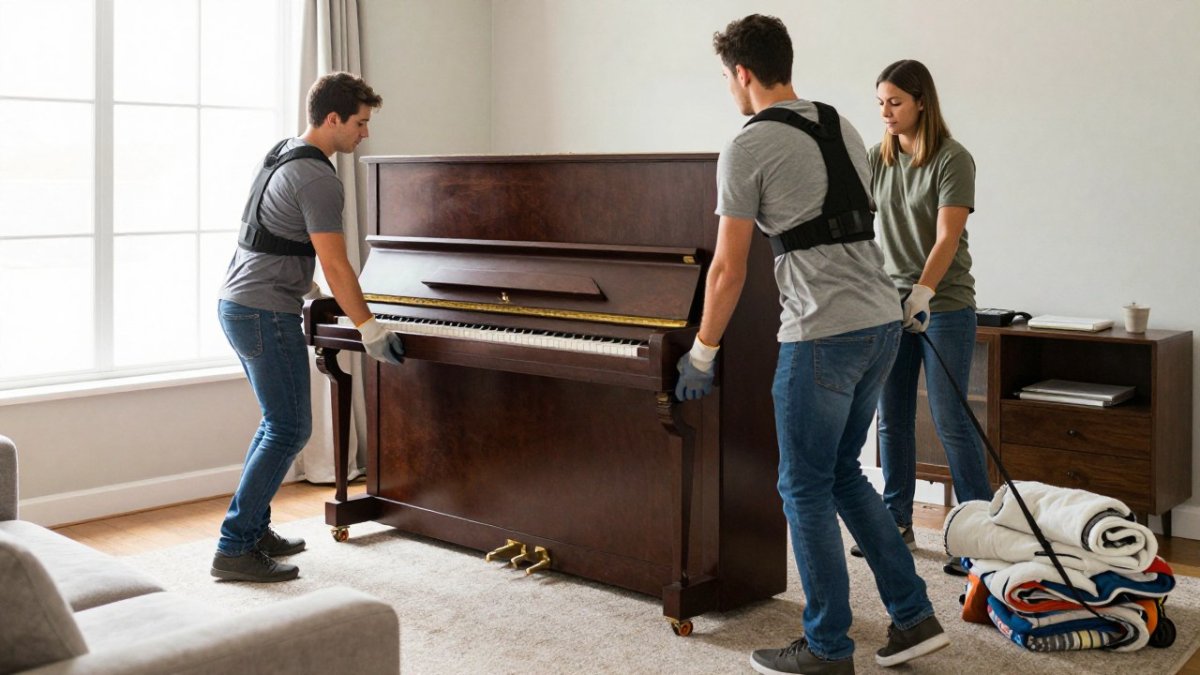
Lift with your legs, keep the piano close to your body, and keep your back straight. Never twist while holding weight.
Weight distribution matters as much as technique. Our guide to transporting heavy furniture safely covers the full lifting sequence.
Watch out: lifting a piano by the legs or the lid is how people get hurt and how instruments get broken.
Loading, Strapping, and Securing the Piano for the Drive
Loading is where a good move turns into an insurance claim. The piano has to go in one way, sit against one wall, and be strapped in more than one direction. Get the sequence right and the drive is boring, which is exactly what you want.
Position the Piano in the Truck
Load the piano against the front wall of the truck, standing upright, with the keyboard side facing the cab. Never lay a piano on its back for a long drive. The internal parts, the action, and the plate are built to sit one way, and laying it down puts stress on the pinblock and the action brackets. On an upright, the heaviest part of the case is the bottom, so keep the base flat on the floor and the top against the wall.
Use a Ramp, Not a Lift
Use a truck ramp for the load-in and keep the ramp angle shallow. For a deeper step-by-step on transporting large furniture items, see our full guide. A steep ramp turns a controlled roll into a slide, and a piano that gets away on a ramp is a hospital visit waiting to happen. Two people control the dolly on the ramp: one at the top steering, one at the bottom braking.
Strap in at Least Two Directions
Secure the piano with heavy-duty straps in at least two directions. Run one strap low across the base, pulling the piano toward the front wall, and a second strap high across the upper case, pulling it toward the side wall. On an upright, a third strap over the top is cheap insurance. Use ratchet straps rated for the load, not bungee cords, and pad every contact point as described in the finish section.
Load Around the Piano, Not On It
Put nothing heavy on top of the piano, and do not use it as a wall for other furniture. A sofa leaning against a piano case will dent the lid and press the instrument off its strapping. Load the piano first or last, depending on the truck layout, and keep the space around it clear so the straps stay tensioned.
Check the Load Before You Drive
Stop after the first few miles and check every strap. Nylon settles, blankets compress, and a strap that felt tight in the driveway can be loose by the end of the street. Re-tension, then check again at the first fuel stop.
Watch out: a piano that is strapped only at the base will tip on the first hard turn. The high strap is not optional, and it should pull toward a wall, not toward open floor space.
Hiring Professional Piano Movers in Carteret County
Hiring professional piano movers in Carteret County is the right call for grand pianos, staircases, and tight hallways. Ask three questions before you book:
- Are you insured, and what does the policy cover?
- Do you carry piano boards and skid boards?
- How many people will be on the crew?
Get the quote in writing and confirm the pickup window. For a broader look at choosing help, read our local guide to hiring professional furniture movers.
If you are downsizing and the piano is leaving for good, Le Rouge Tete in Morehead City offers consignment with a 50/50 split and no end dates on consignments.
After the Move: Tuning, Humidity Control, and Insurance
Let the piano sit for a few weeks before tuning. Wood needs time to adjust to the new room, and a piano tuned on day one will drift.
Control humidity with a room dehumidifier in summer and a humidifier in winter.
Check your homeowner’s policy before the move. Many policies cover instruments in transit only if you add a rider.
Moving a piano safely takes planning, the right dolly, and enough hands.
Frequently Asked Questions
Can two people lift an upright piano?
Two strong adults can lift a small upright piano for a few seconds, but an upright typically weighs 300 to 500 pounds, so two people alone are a back injury waiting to happen. Plan on at least three or four helpers and a furniture dolly to carry the weight. Lift with your legs, keep the piano’s center of gravity close to your body, and never twist at the waist while holding a load.
Can you lay a piano on its back for transport?
A grand piano travels on its side on a skid board, and pianos should generally not be laid flat on their back. Laying an upright on its back puts stress on the soundboard, the casters, and the action, and it can shift the internal components. If a tight turn forces an angle, keep it brief and support the piano with moving blankets and straps. When in doubt, hire professional piano movers who have the right equipment.
Can you use furniture sliders to move a piano?
Furniture sliders can help slide a piano a few feet across hardwood floors, but they are not a substitute for a piano dolly over distance or through doorways. Sliders can scratch the finish if the piano tips, and they offer no support on carpet or thresholds. Use a heavy-duty furniture dolly with locking casters, and protect hardwood floors with a plywood runner or moving blankets.
Do I need specialized equipment to move a piano locally in Morehead City?
Yes. A piano dolly rental, moving blankets, packing tape, and securing straps are the minimum. For a grand piano, add a skid board and a truck ramp. Local moves around Morehead City still involve stairs, tight hallways, and humidity, so plan ahead for the help and equipment the move requires.
